Waterloo Battlefield: A Complete Visitor’s Guide
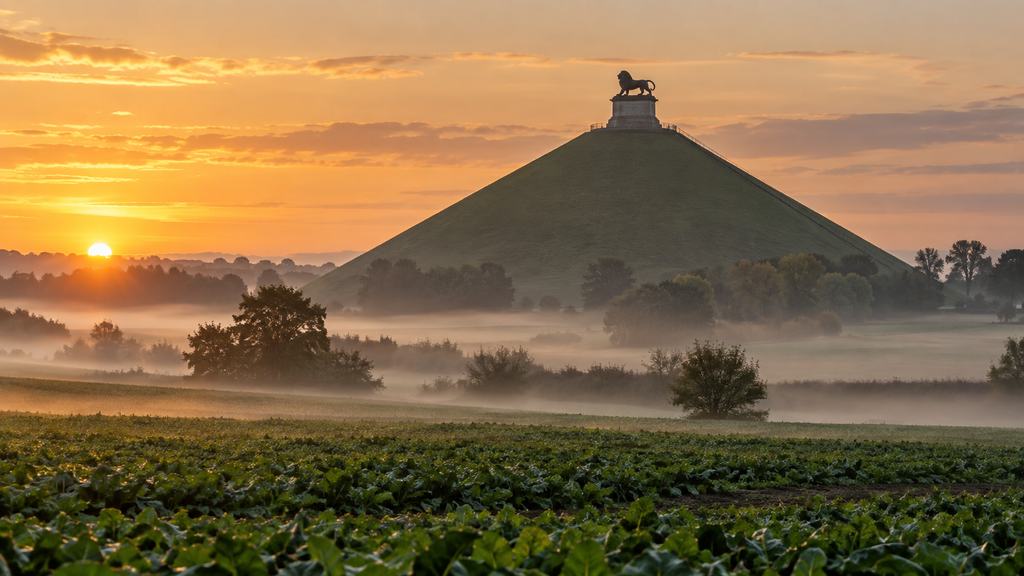
On 18 June 1815, in a patch of rolling Belgian farmland barely 20 kilometres south of Brussels, the Napoleonic era ended in a single day. Napoleon’s Armée du Nord faced the Duke of Wellington’s Anglo-allied army, and at the decisive moment Marshal Blücher’s Prussians arrived on the French flank. By nightfall, roughly 50,000 men had been killed or wounded, and Napoleon was on his way to exile on St Helena.
More than two centuries later, the Waterloo battlefield is one of the best-preserved Napoleonic sites in Europe. The farmland is still farmland, and the fortified farms that shaped the fighting are still standing. The ridge where Wellington’s line held is still there too, so you can walk it. This guide covers everything you need to plan a visit: what to see, how to get there, how long to allow, and how to get the most out of a day on the field.
Why Visit the Waterloo Battlefield?
Plenty of battlefields leave you squinting at an empty field and trying to imagine what happened there. Waterloo is different. It’s compact, with the main action taking place across roughly four kilometres. Several of the key buildings survive, and the landscape is readable. From the top of the Lion’s Mound you can see Hougoumont on the right, La Haye Sainte in the centre, and the ridge Wellington used to hide his infantry from French artillery.
It’s also very accessible. You can go from central Brussels to the battlefield in well under an hour, which makes Waterloo one of the easiest major battlefields in Europe to visit as a day trip.
Free Download
The WWI Battlefield Visitor Checklist
Everything to see, pack, and plan before you visit the Western Front — straight to your inbox.
No spam — just battlefield travel guides. Unsubscribe any time.
A Brief History of the Battle of Waterloo
Napoleon escaped from exile on Elba in February 1815 and landed in France on 1 March. Within weeks he was back in power, and the European powers declared war on him personally. He struck first, marching into what is now Belgium to defeat the Allied armies one at a time before they could combine.
On 16 June he beat the Prussians at Ligny, while Wellington fought a holding action at Quatre-Bras. Wellington then pulled back to a ridge near the village of Mont-Saint-Jean, trusting Blücher’s promise to march to his aid.
The battle opened late on the morning of 18 June, delayed by heavy overnight rain that had turned the ground to mud. The day unfolded in a series of brutal phases:
- The attack on Hougoumont. This began as a diversion against the fortified farm on Wellington’s right and grew into a day-long struggle that drew in thousands of French troops.
- D’Erlon’s infantry assault. A massive infantry attack on the Allied centre-left was repulsed, partly by a charge of British heavy cavalry that then overreached and suffered terrible losses.
- Ney’s cavalry charges. Wave after wave of French cavalry charged into Allied infantry squares during the afternoon without infantry support.
- The fall of La Haye Sainte. The King’s German Legion held this farmhouse in the centre until they ran out of ammunition. It fell in the early evening, putting the Allied line in real danger.
- The Prussian arrival and the Imperial Guard. Prussian troops fought their way into the village of Plancenoit on the French right. Napoleon’s final gamble, an attack by the Imperial Guard, was broken on the ridge, and the French army collapsed.
Wellington later called it “the nearest-run thing you ever saw in your life.” Standing on the ridge, you begin to understand why.
What to See at the Waterloo Battlefield
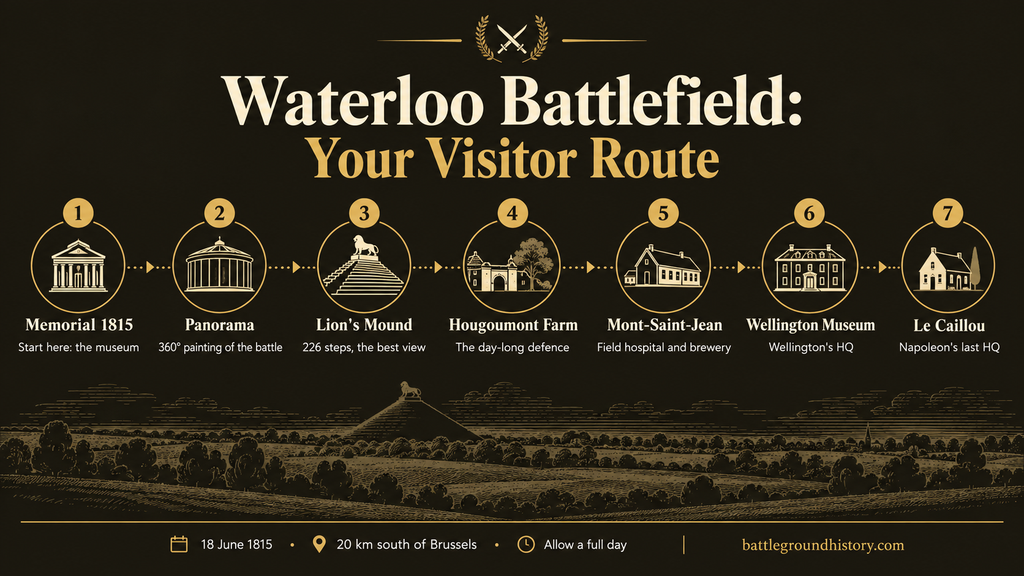
The Waterloo Battlefield Estate (Memorial 1815)
Start here. The Waterloo Battlefield Estate bundles four sites into one ticket: the Memorial Museum, the Panorama, the Lion’s Mound, and Hougoumont Farm. waterloo-tourisme
The Memorial 1815 is an underground visitor centre at the foot of the Lion’s Mound. It opened in 2015 for the bicentenary of the battle and follows a chronological route with films, sound clips, soldiers’ equipment and 3D projections. It does an excellent job of explaining the wider context, from the French Revolution through Napoleon’s rise and fall, before getting into the battle itself. Allow at least an hour and a half. drempelvrij
The Panorama
The Panorama is a circular building next to the Memorial that houses a huge painting of the battle. The painting runs one hundred and ten metres in circumference and wraps a full 360 degrees around the viewer. It was painted in 1912 and focuses on the French cavalry charges. With the soundscape playing around you, it’s surprisingly affecting and a reminder of how Victorian and Edwardian audiences “experienced” battles before cinema. drempelvrij
The Lion’s Mound (Butte du Lion)
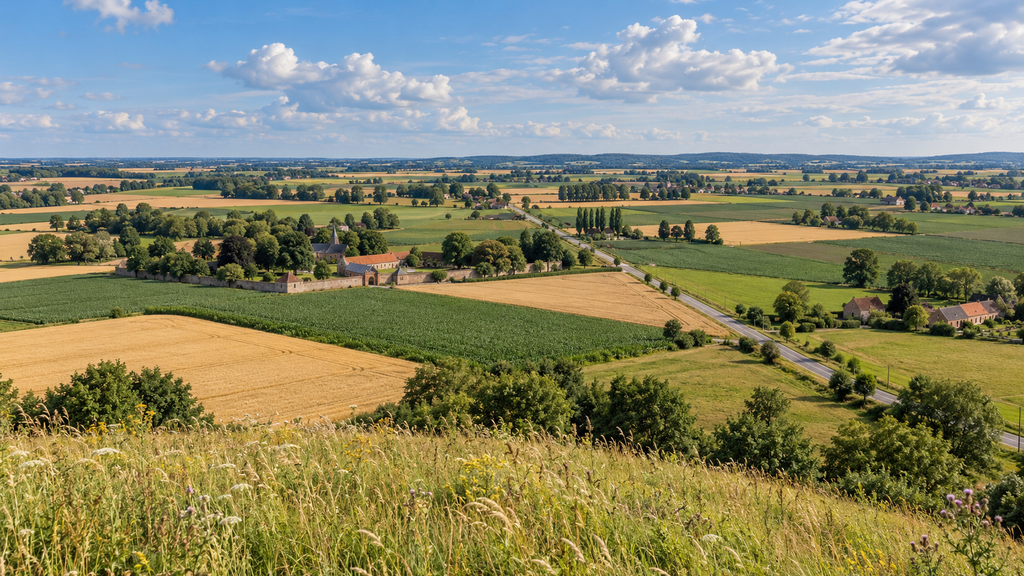
You can’t miss it. This vast artificial hill, around 40 metres high, was built in the 1820s on the spot where the Prince of Orange was wounded. It’s topped by a cast-iron lion facing towards France. The climb is 226 steps, and the view from the top is the single best way to understand the battlefield.
A word of honesty: the mound was built by removing earth from the Allied ridge, which altered the landscape Wellington fought on. Supposedly, when Wellington returned, he complained that they had ruined his battlefield. Even so, the view is essential. Bring the map from the Memorial and pick out the key positions before you walk them.
Hougoumont Farm
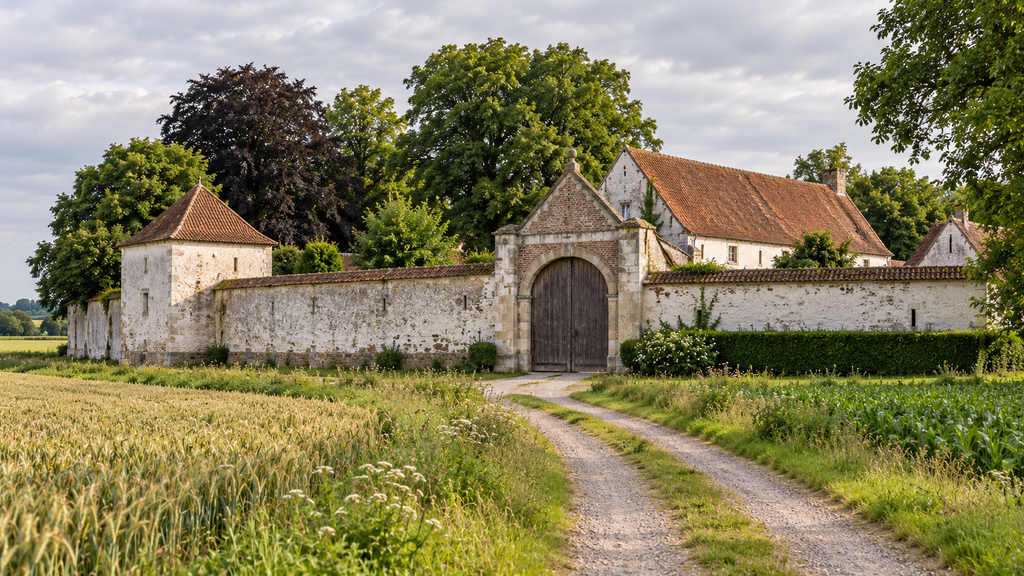
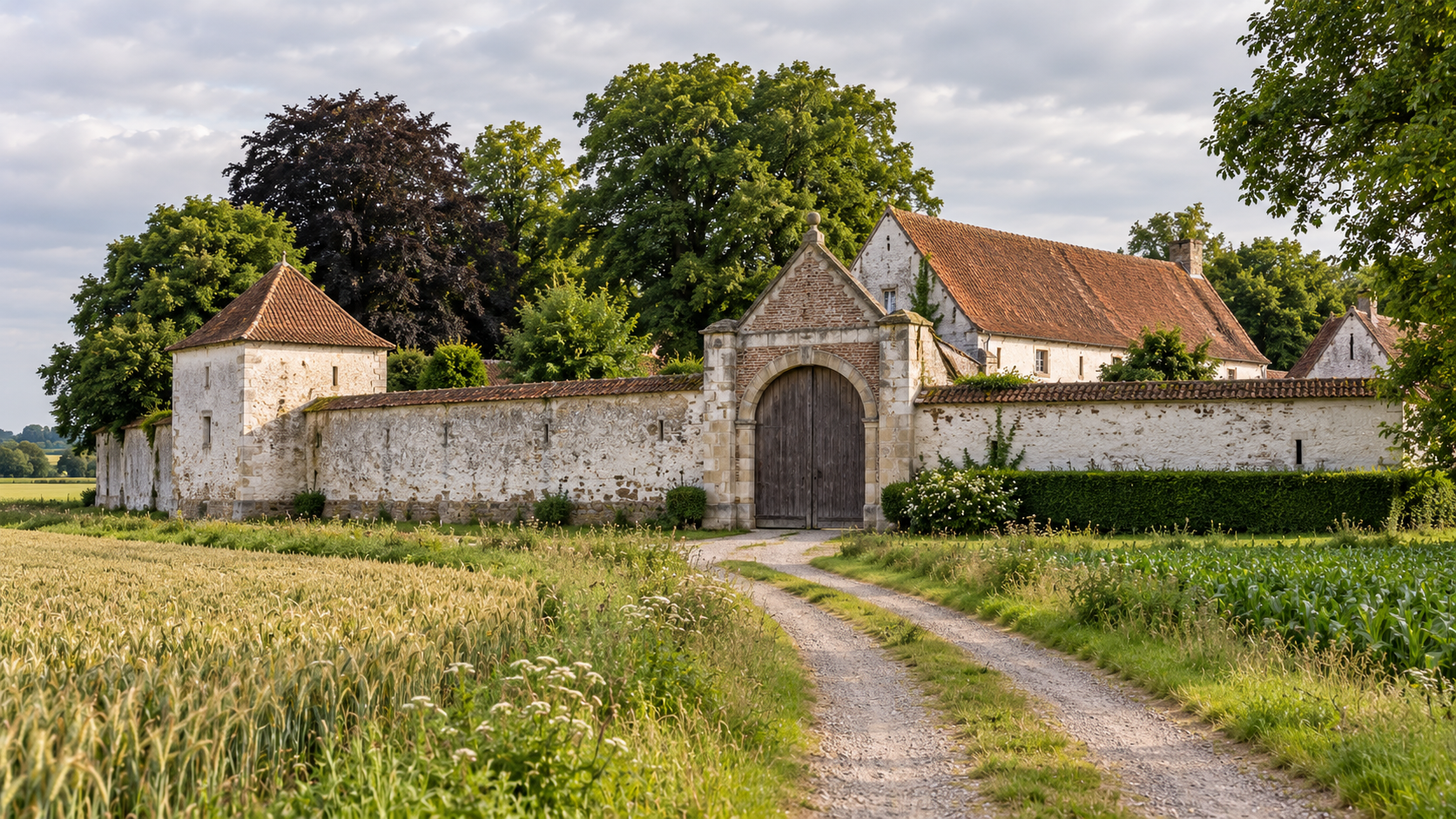
If you only walk to one place, make it Hougoumont. This walled farm complex on Wellington’s right flank was held all day by British Guards and German troops against repeated French attacks. At one point, French soldiers forced the north gate, and the defenders physically pushed it shut again. It was one of the defining moments of the battle.
The farm was restored for the bicentenary and now includes a small multimedia exhibition. An electric shuttle crosses the battlefield between the Memorial 1815 and Hougoumont Farm, but walking there across the fields (about 20–25 minutes) gives you a much better sense of the distances involved. waterloo1815
La Haye Sainte
The farmhouse in the centre of the Allied line is still a working private farm, so you can’t go inside. You can see it from the Brussels–Charleroi road, and there are memorial plaques on the walls to the King’s German Legion. Take care with traffic, as the road is busy and the verges are narrow.
Mont-Saint-Jean Farm
Just behind the Allied line, this farm served as a field hospital for Wellington’s army during the battle. Today it houses a small museum on the medical side of the battle and a microbrewery, which makes it a good lunch stop.
The Wellington Museum (Waterloo Town)
The Wellington Museum is in the old coaching inn in the centre of Waterloo town, a few kilometres north of the battlefield. It’s where Wellington made his headquarters and wrote his victory despatch. The rooms are small, but they’re full of atmosphere. Look for the room where Sir Alexander Gordon, Wellington’s aide-de-camp, died of his wounds.
Napoleon’s Last Headquarters (Le Caillou)
South of the battlefield in Vieux-Genappe, this farmhouse is where Napoleon spent the night before the battle. It’s a quieter, more personal museum, and it’s the natural place to finish a day that has mostly been seen from the Allied side.
Tip: The Pass 1815 combines the three main Battle of Waterloo museums: the full Waterloo 1815 Memorial visit, the Wellington Museum, and Napoleon’s Last Headquarters in Genappe. It’s valid for a year. If you plan to see all three, it’s the best-value option. museewellington
Opening Hours
The Battlefield Estate is open daily. From September to October it’s open 10:00–18:30, and from April to June 10:00–18:30. July and August hours are 9:30–19:00, and November to March hours are 10:00–17:30. Hougoumont opens at 11:00 year-round, and in winter only the outside areas can be visited. waterloo-tourismewaterloo-tourisme
Always check the official site before you travel, especially around the 18 June anniversary and public holidays.
How to Get to Waterloo Battlefield
From Brussels by Train and Bus
Take a train from Brussels (Midi, Central or Nord) to Braine-l’Alleud, which takes around 20 minutes. From there, a bus connects the station with the Memorial, or a taxi takes about ten minutes. Note that Waterloo station is closer to the Wellington Museum than to the battlefield itself. Many first-time visitors get off at the wrong stop. drempelvrij
By Car
The Memorial is just off the R0 Brussels ring road, and it has a spacious car park with numerous accessible spaces. A car is the easiest way to link the battlefield with the Wellington Museum and Le Caillou in one day. drempelvrij
From the UK
From the UK, the Eurostar to Brussels makes Waterloo an easy long weekend. If you’re driving, the Eurotunnel or Dover–Calais ferry puts you about three hours from the battlefield. That’s close enough to combine with the Ypres Salient on the same trip. See our guide to [Visiting Ypres: The Menin Gate, Tyne Cot and the Salient] (internal link).
Guided Tours
A guided tour is worth it if you want the battle brought to life by someone who knows every hedge and sunken lane. Tours from Brussels usually include transport and entry.
How Long Do You Need?
- Half a day: Memorial, Panorama, Lion’s Mound and Hougoumont
- A full day: Add a walk along the ridge, Mont-Saint-Jean, the Wellington Museum and Le Caillou
- Two days: Add the Ligny and Quatre-Bras battlefields (16 June 1815) to follow the full campaign
Best Time to Visit
Spring and early autumn offer the best balance of good walking weather and smaller crowds. The busiest times are 18 June (the battle’s anniversary) and summer weekends, when re-enactments take place. Weekdays are quieter. drempelvrij
Large-scale re-enactments are traditionally staged around major anniversaries, with thousands of living-history participants, so tickets sell out months ahead. If you’d rather have the field to yourself, go on a weekday in May or September.
Accessibility
The Memorial is fully wheelchair accessible, with step-free entry, adapted toilets, and free wheelchair loan on site. The Lion’s Mound, with its 226 steep steps, is not accessible. The battlefield paths are unpaved farm tracks that can be muddy after rain. drempelvrij
Where to Stay Near Waterloo Battlefield
Most visitors stay in Brussels, which gives you the widest choice of hotels and an easy train connection. For a quieter, more atmospheric base, look at Waterloo town itself or the nearby villages of Braine-l’Alleud and Genappe. Some small hotels and B&Bs are within walking distance of the field.
Practical Tips for Visiting Waterloo
- Wear proper footwear. The fields are heavy clay, just as they were in 1815. Walking boots are sensible most of the year.
- Climb the mound first. Getting the overview before you walk makes everything else fall into place.
- Download a map or app. Signage on the open battlefield is limited once you leave the Memorial.
- Read up before you go. The battle makes far more sense if you know the sequence of events.
- Waterloo: The History of Four Days, Three Armies and Three Battles by Bernard Cornwell
- Waterloo: Four Days that Changed Europe’s Destiny by Tim Clayton
- How the French Won Waterloo – or Think They Did by Stephen Clarke
Final Thoughts
Waterloo is one of those rare places where the landscape still tells the story. Stand on the ridge at the end of the day, look south towards the inn at La Belle Alliance where Wellington and Blücher are said to have met after the battle, and you’ll understand why this small stretch of Belgian farmland still draws visitors from all over the world.
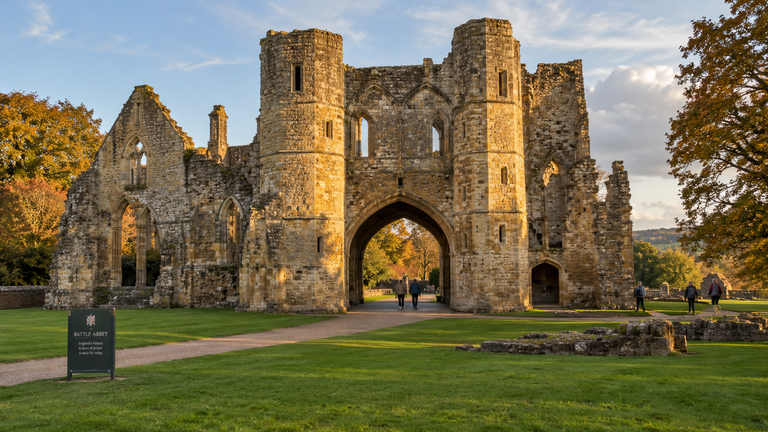
If Waterloo sparks an interest in Europe’s older battlefields, read our guides to Agincourt and the Battle of Hastings site at Battle Abbey next. Or head back to our pillar guide, Europe’s Greatest Ancient and Medieval Battlegrounds.