Thermopylae: Visiting the Pass Where 300 Spartans Made Their Stand
Few place names carry as much weight as Thermopylae. In 480 BC, a small Greek force led by King Leonidas of Sparta held a narrow coastal pass against the vast invading army of Persia’s King Xerxes. They lost the battle, but won a place in history that has lasted nearly 2,500 years.
Visiting Thermopylae today is a quieter, more surprising experience than most people expect. There is no grand ancient ruin, and the sea that once hemmed the pass in has retreated kilometres away. What you will find is a striking bronze statue of Leonidas, the small hill where the last defenders fell, a modern visitor centre, and steaming hot springs that gave the place its name: the Hot Gates.
This guide covers what happened here, what to see, how to get there from Athens, and how to make the most of a visit to one of the most famous battlefields in the world.
What Happened at Thermopylae in 480 BC?
In the late summer of 480 BC, Xerxes marched south into Greece with one of the largest armies the ancient world had seen. To reach Athens and the cities of the south, his army had to pass along a thin strip of land between the mountains and the Malian Gulf. At its narrowest points, the pass was only wide enough for a cart or two.
Free Download
The WWI Battlefield Visitor Checklist
Everything to see, pack, and plan before you visit the Western Front — straight to your inbox.
No spam — just battlefield travel guides. Unsubscribe any time.
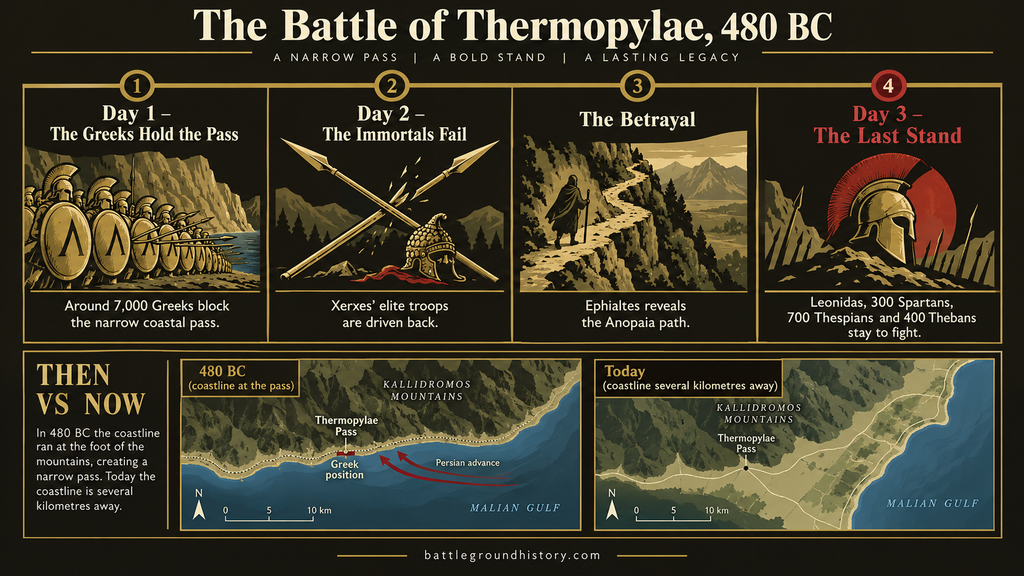
An allied Greek force of roughly 7,000 men took position there under Leonidas, rebuilding an old defensive wall built by the Phocians. Their aim was to buy time while the Greek fleet fought the Persian navy at nearby Artemisium.
For two days the Greeks held. The narrow ground cancelled out Persia’s numbers, and wave after wave of attackers, including Xerxes’ elite Immortals, were driven back.
Then came the betrayal. A local man named Ephialtes showed the Persians a mountain track, the Anopaia path, that led around the Greek position. Learning they were about to be surrounded, Leonidas sent most of the army away. He stayed with his 300 Spartans, alongside around 700 Thespians and 400 Thebans, to fight a rearguard action.
On the third day, the remaining defenders advanced into the open ground and fought until their spears broke. They made a final stand on a small hillock, where, according to the historian Herodotus, they fought on with swords, hands and teeth until they were overwhelmed.
Xerxes went on to burn Athens, but the delay mattered. Within a year, the Greeks had defeated the Persians at Salamis and Plataea. Thermopylae became a lasting symbol of courage against impossible odds.
Why the Thermopylae Battlefield Looks So Different Today
The first thing most visitors notice is that there is no pass. In 480 BC, the sea came right up to the foot of the mountains, leaving a strip of land that was in places only a few metres wide. Today, the coastline sits several kilometres to the east.
The change was caused by the Spercheios River and the surrounding streams, which have carried silt into the Malian Gulf for over two millennia. The narrow corridor the Spartans defended is now a wide plain of farmland, crossed by the old national road and the modern motorway.
It helps to stand with your back to the mountains and imagine the sea lapping at the road in front of you. Suddenly, the Greek strategy makes sense: with cliffs on one side and water on the other, numbers counted for very little.
What to See When Visiting Thermopylae
The main sites sit close together beside the old Athens–Lamia national road, so you can see everything on foot in two to three hours.
The Leonidas Monument
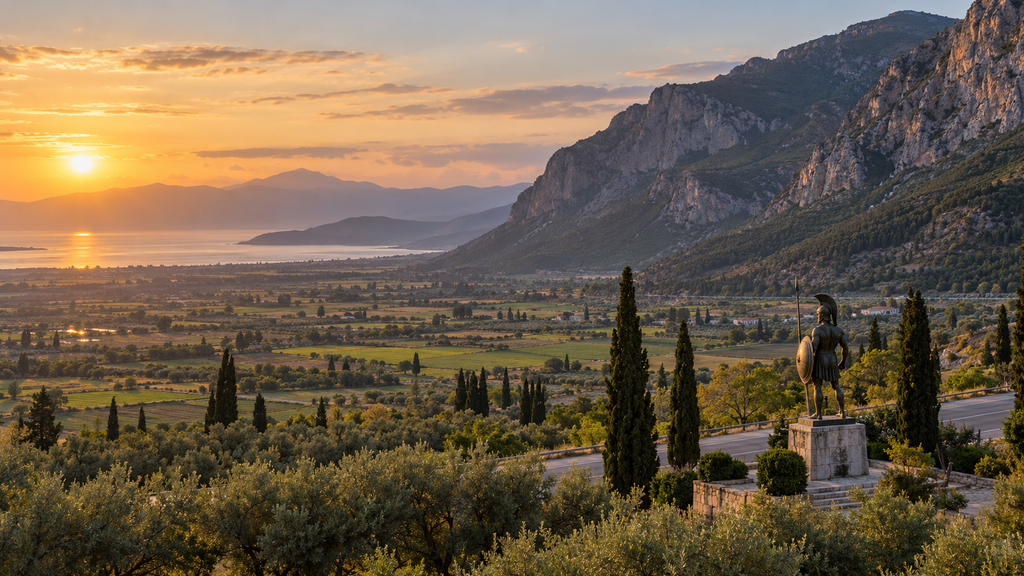
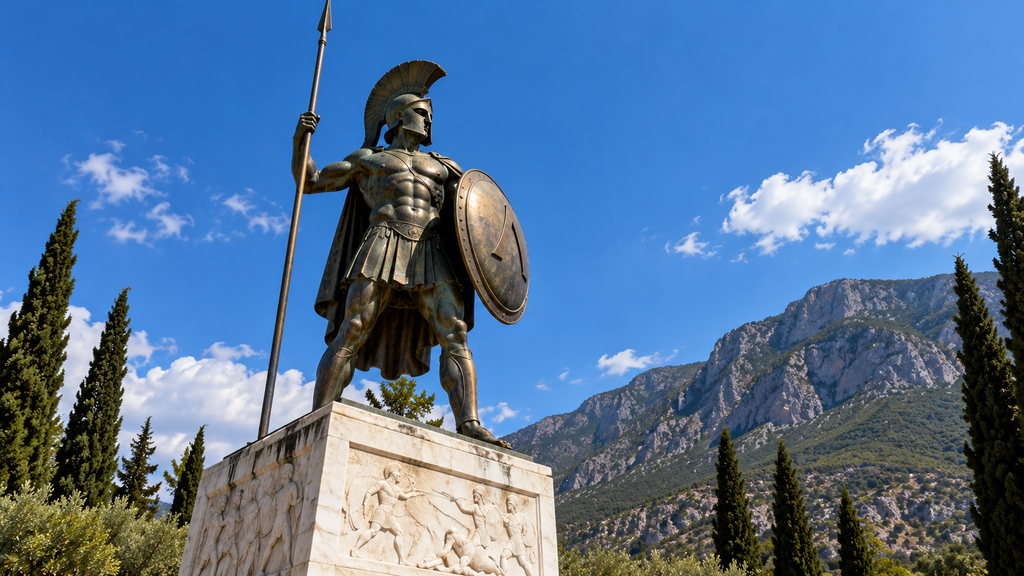
The centrepiece of any visit is the bronze statue of King Leonidas, unveiled in 1955. He stands with shield and spear raised, facing the hill where his men made their final stand.
Beneath him, the base carries the words Molon Labe, meaning “come and take them”. It was Leonidas’ reported reply when Xerxes demanded the Greeks hand over their weapons. Relief panels around the base depict scenes from the battle.
The Thespian Monument
Next to Leonidas stands a modern memorial to the 700 men of Thespiae who chose to stay and die alongside the Spartans. Their sacrifice is often left out of popular retellings, so this monument is worth a moment of your time.
Kolonos Hill: The Site of the Last Stand
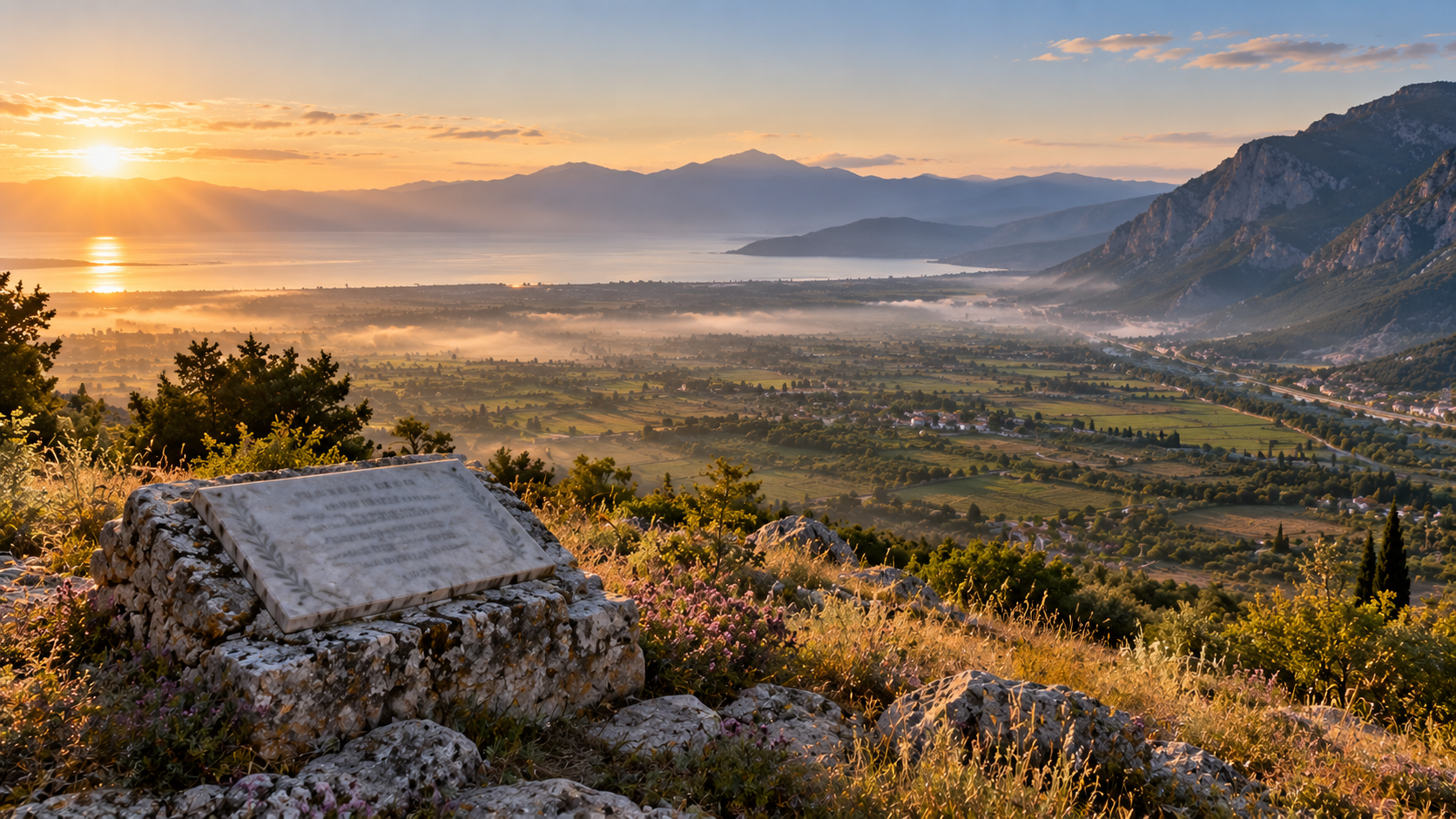
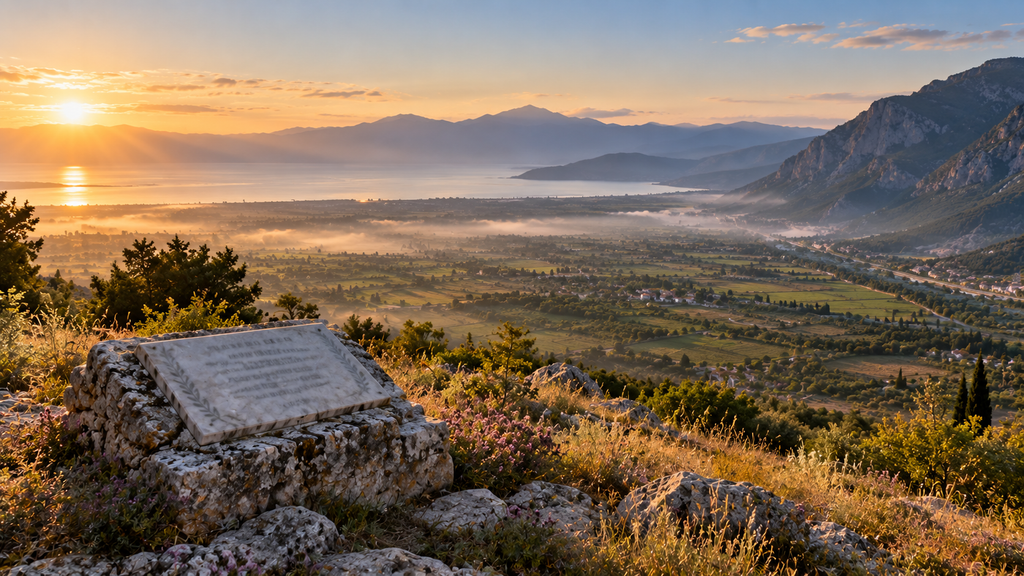
Across the road from the statue, a short path climbs the low hill of Kolonos. This is where the last defenders gathered after Leonidas fell. Archaeologists working here in the 20th century found large numbers of Persian arrowheads, matching Herodotus’ account.
At the top, a stone plaque carries the famous epitaph by the poet Simonides:
Go tell the Spartans, stranger passing by, that here, obedient to their laws, we lie.
The view from the summit takes in the whole plain. It is the best place to picture the battle unfolding below.
The Thermopylae Historical Information Centre
Opened in 2010, this small modern museum sits beside the Leonidas Monument. It contains no ancient finds. Instead, it uses a short film, interactive digital tables and a 3D presentation to explain the battle and the ancient landscape.
It is worth visiting before you climb Kolonos Hill, as it makes sense of what you are looking at. Admission is around €5, while the monuments themselves are free.
The Hot Springs
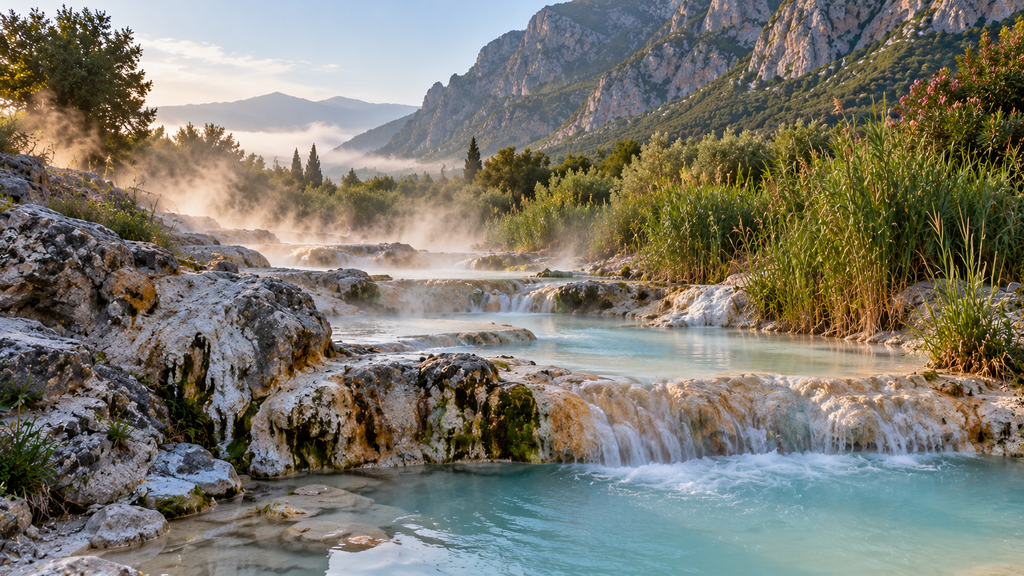
Thermopylae means the Hot Gates, after the sulphurous springs that still flow from the foot of the mountains. A short walk from the monuments, warm, milky-blue water runs through channels and pools beside the road. Locals bathe here year-round, and it makes an unusual end to a battlefield visit.
Be aware the smell of sulphur is strong, and the free pools are informal, with limited facilities.
The Anopaia Path
For keen walkers, sections of the mountain path that Ephialtes showed the Persians can still be hiked. Routes vary in difficulty, and parts are poorly waymarked, so go with a local guide or a good map and plenty of water.
How to Get to Thermopylae from Athens
Thermopylae lies roughly 200 km north-west of Athens, around 18 km south-east of the city of Lamia.
By car. Driving is the easiest option. Take the A1 motorway north towards Lamia; the journey takes about two and a half hours. Leave at the Thermopylae exit and follow signs for the monument, where there is free parking.
By bus. KTEL buses run regularly from Athens to Lamia. From Lamia, take a taxi for the final stretch, and agree a return pickup time, as taxis are scarce at the site.
On a guided tour. Several day tours from Athens combine Thermopylae with Delphi or Meteora. This is the simplest choice if you don’t want to drive, and a good guide brings the empty plain to life.
When to Visit Thermopylae
Spring (April to June) and autumn (September to October) are the best times. The weather is warm but not punishing, and the hills are green in spring.
July and August can top 35°C, and there is little shade on Kolonos Hill. If you visit in summer, arrive early in the morning. The battle itself was fought in late summer, so an August visit has its own atmosphere.
The information centre’s opening hours change through the year and differ between weekdays and weekends. Check the latest times before you travel, especially on Greek public holidays.
Where to Stay Near Thermopylae
Most visitors see Thermopylae as a day trip from Athens, but staying nearby lets you visit in the quieter early morning or evening.
- Lamia – the nearest city, with the widest choice of hotels and restaurants, and its own castle overlooking the town.
- Kamena Vourla – a seaside spa town about 25 minutes’ drive away, known for its thermal baths.
- Delphi – about two hours away, ideal if you are combining the two sites on a central Greece road trip.
Tips for Visiting Thermopylae
- Visit the information centre first. The film and maps make the empty landscape far easier to read.
- Wear sturdy shoes for the climb up Kolonos Hill; the path is short but uneven.
- Bring water, sunscreen and a hat in summer, as there is little shade.
- Pack swimwear and an old towel if you plan to try the hot springs.
- Read Herodotus’ account (Book 7 of The Histories) before you go. It is still the main source for the battle.
- Allow two to three hours for the monuments, museum and hill, longer if you plan to bathe or hike.
Visiting Thermopylae: Frequently Asked Questions
Is it free to visit Thermopylae?
Yes. The Leonidas Monument, the Thespian Monument, Kolonos Hill and the hot springs are all free and open-air. The Historical Information Centre charges a small entry fee of around €5.
How long do you need at Thermopylae?
Two to three hours is enough to see the monuments, the museum and Kolonos Hill. Add an hour or more for the hot springs or a walk on the Anopaia path.
Can you still see the original pass?
Not as it was. River silt has pushed the coastline several kilometres east, so the narrow pass is now a wide plain. Kolonos Hill, the site of the last stand, is the most authentic surviving feature.
Can you do Thermopylae as a day trip from Athens?
Yes. It is about two and a half hours each way by car, and many organised tours combine it with Delphi or Meteora.
Were there really only 300 Spartans?
The 300 were the Spartan citizen-soldiers who formed Leonidas’ bodyguard. They fought alongside several thousand other Greeks, and on the final day around 1,100 Thespians and Thebans stayed with them.
Final Thoughts
Thermopylae isn’t a site of grand ruins. Its power lies in the story and in the landscape. Standing on Kolonos Hill, reading Simonides’ words and looking out over the plain, it is easy to understand why this small patch of central Greece still draws visitors from around the world.
If you are planning a wider trip around Europe’s ancient battlegrounds, take a look at our guide to Europe’s Greatest Ancient and Medieval Battlegrounds and our Marathon Battlefield visitor guide. And if you’ve stood on Kolonos Hill yourself, we’d love to hear about it in the comments below.