The Complete Guide to Visiting the D-Day Beaches in Normandy
Published for Battleground History · Last updated June 2026 · Estimated read: 18–22 minutes
“They fought so that we might live in freedom. The least we can do is remember — and go.”
On 6 June 1944, more than 156,000 Allied troops crossed the English Channel and landed on five beaches along a 50-mile stretch of the Normandy coastline. In a single day, the course of the Second World War — and the history of Europe — was changed forever.
More than 80 years later, that coastline remains one of the most visited, most moving, and most historically significant stretches of land on earth. The beaches, bunkers, cemeteries, and museums of Normandy receive millions of visitors every year, from veterans’ families completing a pilgrimage to backpackers on a budget road trip. Every single one of them leaves changed.
Free Download
The WWI Battlefield Visitor Checklist
Everything to see, pack, and plan before you visit the Western Front — straight to your inbox.
No spam — just battlefield travel guides. Unsubscribe any time.
This guide is designed to help you plan a meaningful, well-organised visit to the D-Day beaches — whether you have one day or one week, whether you’re travelling solo, as a couple, or with children. We cover every beach, every essential site, the best tours, where to stay, and how to approach a place that is as much memorial as destination.

Understanding the Five D-Day Beaches
The five landing beaches are spread across roughly 50 miles of coastline and have distinct characters, histories, and visitor experiences. Understanding which nation fought where — and what happened at each — helps you plan a more coherent visit rather than simply ticking sites off a list.
Utah Beach (American)
Utah was the westernmost beach, located on the Cotentin Peninsula. Despite being added to the plan late, it saw the fewest casualties of any beach — partly due to a fortunate navigational error that brought the first wave ashore at a less heavily defended section.
The Utah Beach Museum (Musée du Débarquement Utah Beach) is outstanding — modern, well-curated, and home to a rare P-47 Thunderbolt aircraft. The beach itself is wide, largely undeveloped, and gives a genuine sense of scale. A short drive away is Sainte-Mère-Église, the first French town liberated by the Allies, where a replica of paratrooper John Steele’s parachute hangs permanently from the church steeple.
Omaha Beach (American)
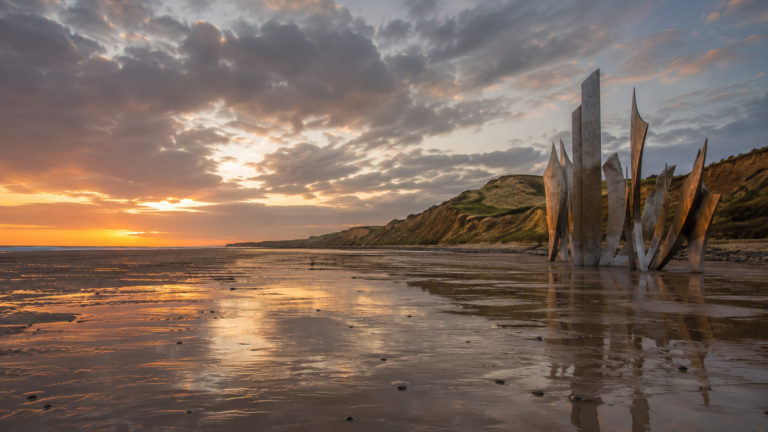
Omaha is the most famous and the most haunting of the five beaches. The American 1st and 29th Infantry Divisions, along with Rangers, faced devastating fire from German positions on the bluffs above. Of roughly 2,000 American casualties on D-Day, the vast majority fell here.
Standing on the wide, flat sand of Omaha — with the bluffs behind you and the grey Channel ahead — it becomes immediately, viscerally clear how exposed those men were. Pointe du Hoc, a few miles west, is one of the most dramatic and least altered sites on the entire Normandy coast: bomb craters and German bunkers remain exactly as they were left in 1944.
The American Cemetery at Colleville-sur-Mer sits on the bluffs above Omaha. The 9,388 white marble crosses and Stars of David, arranged in perfect lines against a backdrop of manicured grass and the sea, is one of the most affecting sights in all of Europe.
Gold Beach (British)
Gold was the central British beach. The 50th Northumbrian Infantry Division landed here and, by the end of D-Day, had pushed further inland than any other Allied unit — reaching the outskirts of Bayeux. The town fell the following day, becoming the first major French town to be liberated.
Arromanches, just east of Gold Beach, is one of the most remarkable sites on the entire coast. Here the Allies constructed Mulberry Harbour B — a prefabricated artificial harbour of over 600,000 tonnes of concrete, towed across the Channel in pieces. The concrete pontoons still sit in the water today. The Arromanches 360° Cinema offers a compelling introduction, and the original D-Day Museum (Musée du Débarquement) in the town is one of the best on the coast.
Juno Beach (Canadian)
Juno was the Canadian beach — and Canada’s involvement in Normandy is often underappreciated by visitors from other countries. The 3rd Canadian Infantry Division and 2nd Canadian Armoured Brigade suffered the second-highest casualties on D-Day, yet also achieved the deepest inland advance of any beach by day’s end.
The Juno Beach Centre at Courseulles-sur-Mer is a dedicated Canadian museum and one of the most informative on the coast. It tells the story of the nearly one million Canadians who served in the Second World War, and is staffed partly by Canadian volunteers. The German bunkers at Courseulles have been preserved in-situ and are fascinating to explore.
Sword Beach (British)
Sword was the easternmost beach, landed by the British 3rd Infantry Division. Its mission included linking up with the 6th Airborne Division, which had landed by glider and parachute overnight to seize key objectives — most famously Pegasus Bridge over the Caen Canal, which was captured intact in one of the war’s most audacious operations.
Bénouville, just inland, is home to the Mémorial Pegasus museum — a superb facility built around the original bridge. Meeting veterans’ descendants at the annual commemoration ceremony here is an experience unlike any other on the Normandy coast.
The Essential Sites: What You Cannot Miss
With so many museums, memorials, and preserved sites across Normandy, first-time visitors can feel overwhelmed. These are the non-negotiables — the places that, collectively, give you a complete picture of what happened here.
How Many Days Do You Need?
The honest answer is: more than you think. The D-Day coast is 50 miles wide and the sites are spread across the entire stretch. Visitors who try to “do Normandy in a day” almost always leave wishing they’d stayed longer.
One Day (Absolute Minimum)
If you have only one day, focus on Omaha Beach, the American Cemetery at Colleville-sur-Mer, and Pointe du Hoc. These three sites form the emotional and historical core of the American experience, and can be covered in a long, well-planned day from Paris or Caen.
⚠ Note: One day is not enough to do Normandy justice. If you can possibly manage two or three days, you will be far better rewarded.
Two Days (Recommended Minimum)
Day 1: American sector — Utah, Omaha, the Cemetery, Pointe du Hoc, and Sainte-Mère-Église. Stay overnight in Bayeux or Arromanches.
Day 2: British and Canadian sector — Gold (Arromanches), Juno (Juno Beach Centre at Courseulles), and Sword (Mémorial Pegasus at Bénouville). End with an hour or two in Bayeux itself — the cathedral and the tapestry are extraordinary.
Three to Four Days (Ideal)
Add the Mémorial de Caen (allow a full half day), a visit to La Cambe German Cemetery for perspective, and a deeper exploration of inland sites including the ruins of Saint-Lô and the Abbaye d’Ardenne, where SS soldiers massacred Canadian prisoners in June 1944. A four-day visit allows you to follow the campaign narrative from the beaches inland — which dramatically enriches the experience.
Five or More Days (For the Dedicated)
Extend east into Operation Market Garden territory (a drive to Arnhem and Eindhoven adds a rich coda to the story) or north to the Mont Saint-Michel for a contrast of medieval and modern. Those with a special interest in the airborne operations should visit Sainte-Mère-Église, the Airborne Museum, and the various 82nd and 101st Airborne sites in the bocage country south of Utah.
Guided Tours vs Self-Guided: Which Is Right for You?
This is one of the most important decisions you’ll make when planning a Normandy visit, and there’s no universal right answer. Both approaches have real advantages.
The Case for a Guided Tour
A good Normandy guide — and there are many excellent ones — transforms the experience. They know the family stories behind the gravestones. They know where the first men landed, where exactly the Rangers climbed, which bunker the German officer commanded from. The physical sites are powerful; the stories that animate them are what make visits unforgettable.
Guided tours also solve the logistical challenge of covering multiple sites without a car. Many visitors arriving by train to Bayeux or Caen find a small-group day tour the most practical option.
Recommended: GetYourGuide and Viator both list excellent Normandy guided tours, ranging from half-day Omaha-focused experiences to full-week immersive battlefield tours. Look for guides who specialise in military history rather than general tourist operators.
The Case for Self-Guided
Self-guided travel through Normandy gives you time — time to sit at the cemetery for longer than a tour schedule allows, time to stand alone on the sand at Omaha before the coaches arrive, time to stop at a roadside cross that caught your eye. Some visitors find guided tours too structured for the emotional weight of what they’re experiencing.
If you go self-guided, the D-Day Explorer app and the excellent Rick Steves Normandy audioguides (free online) are invaluable planning and navigation tools. The CWGC (Commonwealth War Graves Commission) website is essential for those tracing family graves.
Where to Stay in Normandy
Your choice of base significantly affects how much you can cover — and how the experience feels. The Normandy coast has accommodation ranging from modest B&Bs to château hotels, and from campsite pitches to luxury gîtes.
Bayeux (Best Overall Base)
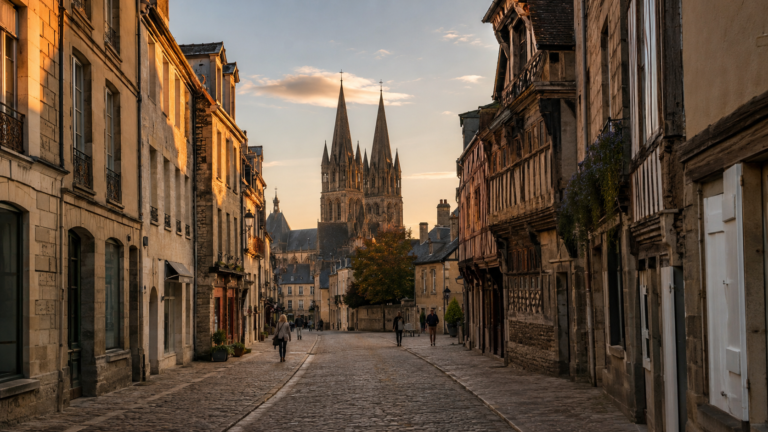
Bayeux is consistently the best base for D-Day battlefield visitors. It was the first town liberated by the Allies, it escaped the wartime bombing that devastated Caen, and its medieval centre — with the famous tapestry and the cathedral — is genuinely beautiful. Accommodation ranges from budget hotels to gorgeous B&Bs in historic townhouses. Most of the beach sites are within a 20–45 minute drive.
Arromanches (Best for Atmosphere)
Staying in Arromanches puts you directly on the coast, overlooking the remaining Mulberry Harbour pontoons. It’s a small town with a handful of hotels and restaurants; it feels appropriately intimate and reflective. Ideal for visitors who want to walk to the beach at dawn or dusk without other tourists.
Caen (Best for Access and Facilities)
Caen is a larger city with more accommodation options, a mainline train station, and easy access to the Mémorial de Caen museum. It was heavily damaged in 1944 and substantially rebuilt, so it lacks the charm of Bayeux — but it’s practical and well-connected.
Rural Gîtes
For those spending several days, renting a gîte (rural self-catering property) in the Norman countryside is a wonderful option. You’ll be surrounded by the bocage hedgerow landscape that shaped so much of the post-D-Day fighting, and you’ll experience the region as a place as well as a memorial. Many gîtes are bookable through Booking.com, Vrbo, and Airbnb.
Visiting Normandy Respectfully
The D-Day beaches are simultaneously tourist attractions, active memorials, and sacred ground. Thousands of men are buried in the cemeteries; many more have no known grave. The sites deserve — and reward — a certain attitude.
- Dress modestly at cemeteries and memorials. This is not the place for beachwear, even in summer.
- Keep noise levels appropriate. Large groups should be reminded by their guide or self-remind.
- Do not walk on grave markers or cross rows. Walk the paths between.
- Photography is permitted at most sites, but put the camera down periodically and simply be present.
- Do not remove sand, stones, or any material from the beaches or bunkers. This is a criminal offence at many sites.
- If you find a war relic — particularly metal objects — do not touch it. Unexploded ordnance is still occasionally found in Normandy. Report it to local authorities.
- Take time to read individual names. The cemeteries are not statistics. Every name is a story.

When to Visit Normandy
Normandy is a year-round destination, but each season has distinct advantages and drawbacks.

Practical Information
Entry and Costs
Most of the major D-Day sites are free to enter — including all ABMC-managed sites (the American Cemetery, Pointe du Hoc, Utah Beach Memorial), the beaches themselves, and the CWGC cemeteries. The main costs are the museums, which typically charge €8–€15 per adult. The Mémorial de Caen is the most expensive at around €20, but is also the most comprehensive.
Budget approximately €30–€50 per person per day for museum entries, plus accommodation, food, and transport.
Getting Around
A car is by far the most practical way to visit the beaches. The sites are spread over 50 miles and public transport connections between them are poor. Car hire from Caen station or the airport takes minutes to arrange and gives you full freedom.
If you don’t have a car, a guided tour from Bayeux or Caen is the next best option. Several excellent operators run small-group day tours that cover the key sites efficiently.
Language
English is widely spoken at the major visitor sites, in hotels and restaurants in Bayeux and Caen, and by most guided tour operators. In smaller villages and rural areas, basic French is appreciated and often necessary. Menus in most restaurants will be French-only; a translation app is useful.
Food and Drink
Normandy is one of France’s great culinary regions. Camembert, Livarot, and Pont-l’Évêque cheeses all originate here; the cream-based sauces are exceptional; the seafood — particularly mussels and scallops — is outstanding. Calvados apple brandy is the region’s signature drink. Even on a battlefield itinerary, don’t rush past the food. A long Norman lunch is part of the experience.
Itinerary: The Two-Day D-Day Essential
This itinerary covers the most important sites across both the American and British/Canadian sectors in two full days, based from Bayeux.
Day 1: The American Sector
- Morning: Drive to Utah Beach (45 min from Bayeux). Visit the Utah Beach Museum — allow 90 minutes. Walk the beach. Drive to Sainte-Mère-Église (15 min) — the town centre, the church with the paratrooper, the Airborne Museum.
- Lunch: Return towards the coast. Lunch in Grandcamp-Maisy or at one of the informal restaurants near Pointe du Hoc.
- Afternoon: Pointe du Hoc — allow 60–90 minutes to walk the entire site. Drive to Omaha Beach (15 min). Walk the beach from the Saint-Laurent draw, looking up at the bluffs.
- Late afternoon: American Cemetery at Colleville-sur-Mer. Allow at least 90 minutes; many visitors stay considerably longer. The visitor centre is exceptional.
- Evening: Return to Bayeux (30 min). Dinner in town.
Day 2: Gold, Juno, Sword & Airborne
- Morning: Arromanches — the Mulberry Harbour remains, the D-Day Museum, and Arromanches 360° Cinema. Allow 2 hours.
- Late morning: Courseulles-sur-Mer — Juno Beach Centre (90 minutes minimum). Walk the beach and examine the preserved German bunkers in-situ.
- Lunch: Courseulles or Ouistreham (the ferry port and Sword Beach town).
- Afternoon: Bénouville — Mémorial Pegasus and the Pegasus Bridge. Allow 90 minutes.
- Late afternoon: La Cambe German Cemetery (20 min from Bénouville via the A84). A sobering and important counterpoint. Free entry.
- Evening: Return to Bayeux (15 min). The Bayeux Tapestry closes at 6:30pm (check seasonal hours) — if you haven’t visited, this is worth prioritising before dinner.
Further Reading
The literature on D-Day and the Normandy Campaign is vast. These are the titles most recommended by battlefield guides and historians for visitors.
- D-Day: The Battle for Normandy — Antony Beevor. The best single-volume account. Comprehensive, gripping, and consistently illuminating.
- Overlord — Max Hastings. Focuses on the fighting through Normandy after D-Day, with superb attention to the experience of individual soldiers.
- The Longest Day — Cornelius Ryan. The classic narrative account of D-Day itself, drawing on hundreds of first-hand interviews. First published in 1959; still essential.
- Band of Brothers — Stephen Ambrose. The story of Easy Company, 506th PIR — the paratroopers who jumped into Normandy the night before D-Day and whose story was told in the HBO series.
- Six Months in 1945 — Michael Dobbs. Useful context for understanding the broader strategic picture that made Overlord necessary.
Planning Your Visit: The Essentials

“To visit Normandy is to make a promise — that you will carry the memory forward. It is the most important thing a traveller can do.”
Normandy will ask something of you. It will ask you to slow down, to read the names, to stand in the silence and understand what happened on these quiet beaches more than 80 years ago. Give it what it asks. You will leave richer for it.