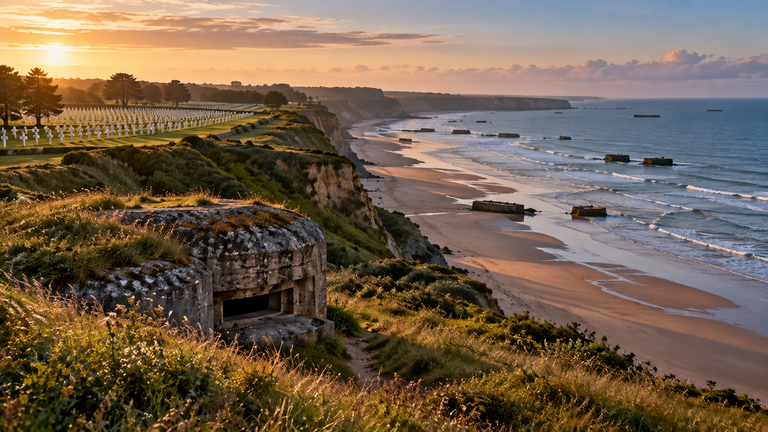
Omaha Beach: What to See, Where to Stay, and How to Honour the Fallen
On the morning of 6 June 1944, American soldiers from the 1st and 29th Infantry Divisions waded ashore at a four-mile stretch of French coastline codenamed Omaha. They were met with withering fire from heavily fortified German positions on the bluffs above. By the end of that day, more than 2,000 American troops had been killed, wounded, or were missing. The beach had been taken — but at a cost that is still difficult to comprehend standing here today.
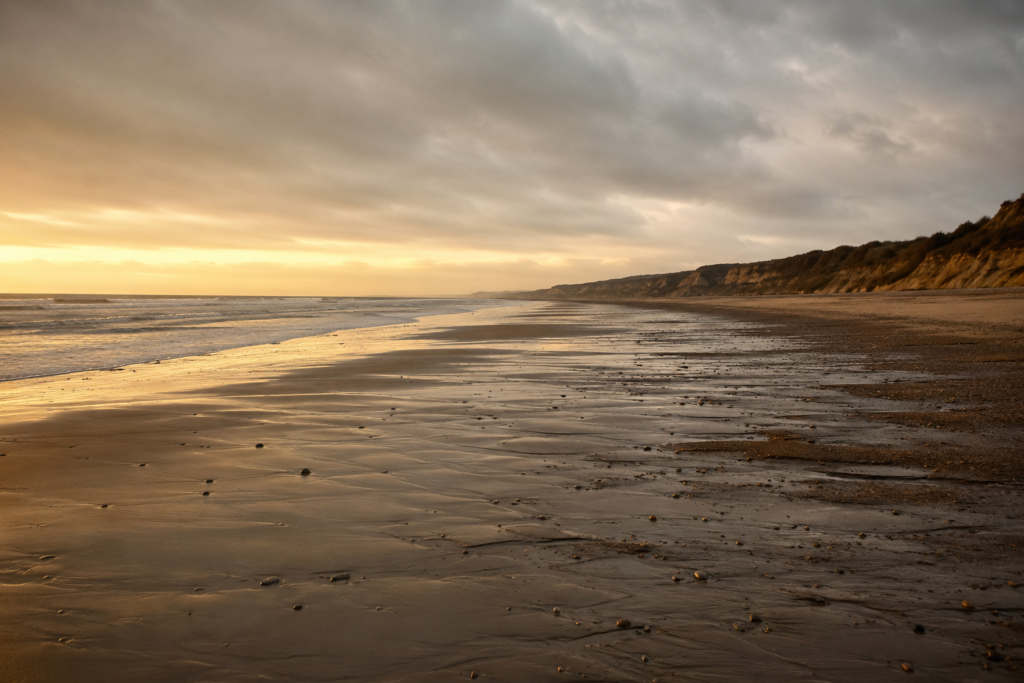
Omaha is the most emotionally charged of the five D-Day beaches. It is also the most visited, drawing hundreds of thousands of pilgrims from the United States, Britain, Canada, and beyond each year. This guide covers everything you need to know to visit Omaha Beach — what to see, where to stay nearby, and how to approach this sacred ground with the reverence it deserves.
“You are about to embark upon the Great Crusade, toward which we have striven these many months.” — General Dwight D. Eisenhower, Order of the Day, 6 June 1944
Understanding Omaha Beach Before You Visit
Omaha Beach stretches between the villages of Vierville-sur-Mer to the west and Colleville-sur-Mer to the east. Unlike the other four D-Day beaches — Utah, Gold, Juno, and Sword — Omaha faced the steepest defensive challenges. The beach was overlooked by high bluffs, and the German defenders of the 352nd Infantry Division were far more numerous and better positioned than Allied planners had anticipated.
Free Download
The WWI Battlefield Visitor Checklist
Everything to see, pack, and plan before you visit the Western Front — straight to your inbox.
No spam — just battlefield travel guides. Unsubscribe any time.
The preliminary naval and aerial bombardment that was supposed to suppress German defences largely missed its targets. Landing craft were swamped in heavy seas. Tanks designed to float to shore sank almost immediately. The men who made it to the beach were pinned down under relentless fire with little cover and no clear path forward.
It was only through extraordinary individual courage — soldiers and officers making split-second decisions under fire — that the breakthrough finally came in the afternoon. Understanding this context before you arrive makes standing on the beach a profoundly different experience.
What to See at Omaha Beach
The Beach Itself
Begin at the beach. Park at the access points near Vierville-sur-Mer or the Les Moulins draw and walk down to the waterline. At low tide, Omaha is wide and flat — it is easy to see both the scale of the assault and the terrible exposure faced by the men trying to cross it.
Several concrete German bunkers remain visible along the bluffs and at beach level, slowly being reclaimed by sand and erosion. Look for the WN62 strongpoint at the eastern end — one of the best-preserved defensive positions on the beach, with unobstructed fields of fire across the entire landing zone.
The beach itself carries no markers or flags at the waterline. Its plainness is part of its power. What happened here is written in the landscape — the bluffs, the draws, the flat expanse between the sea and the first cover — rather than in plaques and monuments.
Omaha Beach Memorial Museum (Musée Mémorial d’Omaha Beach)
Located at Saint-Laurent-sur-Mer, this is the most comprehensive museum dedicated specifically to the Omaha landing. The collection covers the planning and execution of the assault in extraordinary detail, with original equipment, personal effects, weapons, uniforms, and vehicles recovered from the beach and surrounding areas.
Allow at least 90 minutes here. The museum does not flinch from the human cost of the assault, and the personal stories it tells — through letters, photographs, and belongings — give the statistics a human dimension that larger museums sometimes lose. Opening hours and admission prices vary by season; check omaha-beach.org before visiting.
The Normandy American Cemetery at Colleville-sur-Mer
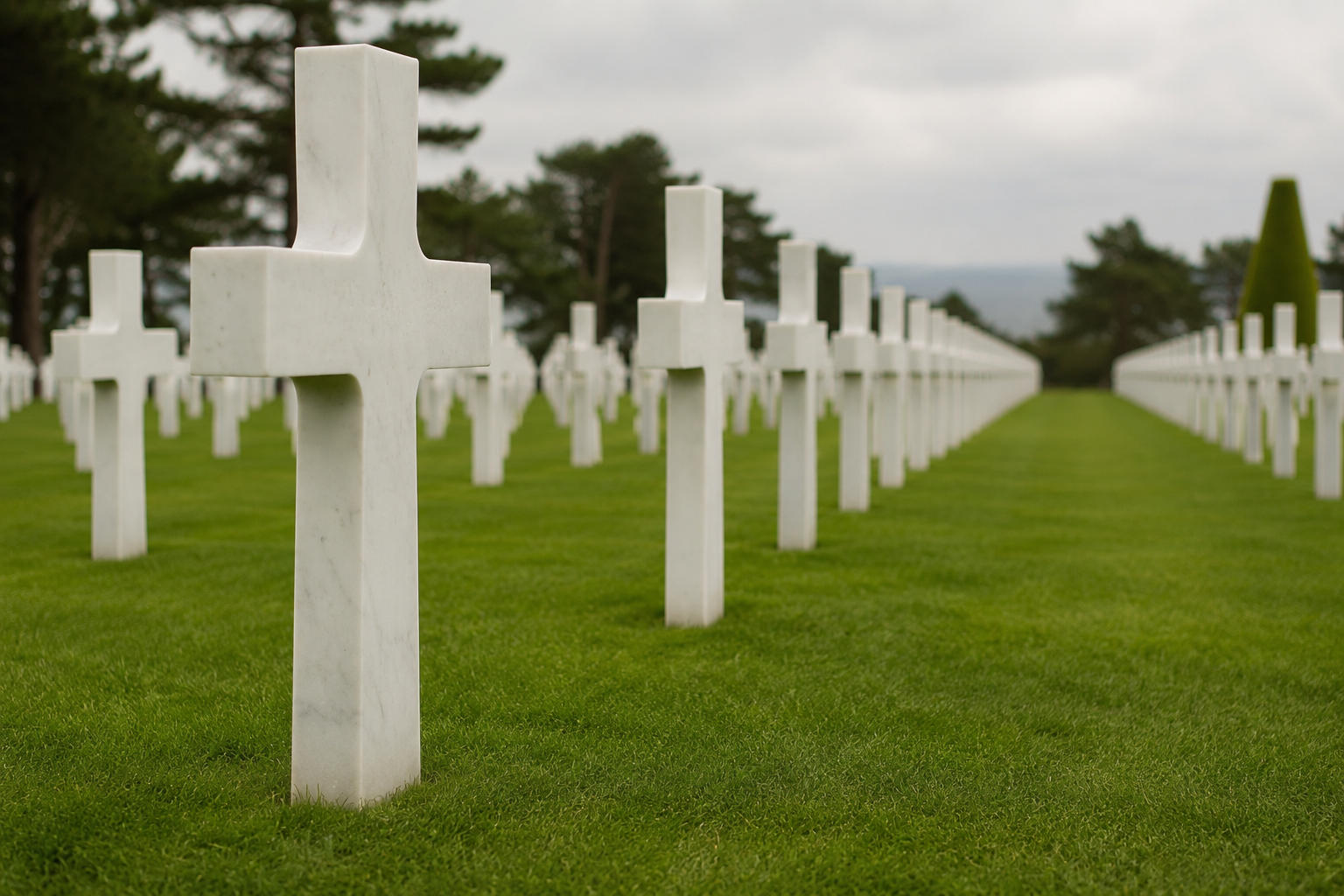
Overlooking Omaha Beach from the bluffs above, the American Cemetery is one of the most moving sites in Europe. Nearly 9,400 American servicemen and women are buried here, their white Carrara marble crosses and Stars of David arranged in perfect lines across 172 acres of immaculate grounds. The scale is breathtaking and, to many visitors, overwhelming.

The visitor centre below the cemetery tells the story of the Normandy campaign through personal stories of the men and women buried here. The Garden of the Missing commemorates more than 1,500 service members whose remains were never recovered. The semicircular memorial at the centre of the cemetery bears the inscription: ‘Here we and all who shall come after us find witness to the price of our freedom.’
The cemetery is operated by the American Battle Monuments Commission and is open daily except Christmas Day and New Year’s Day. Entry is free. Give yourself at least two hours, and bring something warm — the bluffs above Omaha can be exposed and cold even in summer.
Pointe du Hoc
Though not on Omaha Beach itself, Pointe du Hoc is a short drive west and should not be missed. This clifftop promontory was seized by US Army Rangers who scaled 30-metre cliffs under fire on D-Day morning to destroy what were believed to be long-range guns threatening both Omaha and Utah beaches.
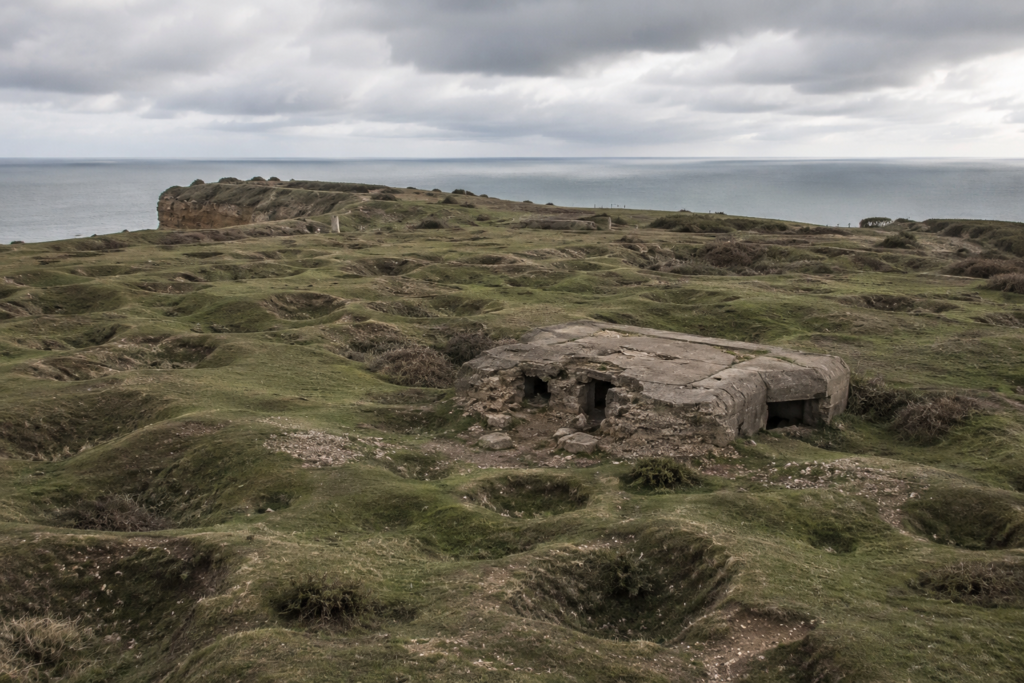
The landscape at Pointe du Hoc is unlike anywhere else in Normandy. The entire headland is still cratered from the pre-landing bombardment, and the German concrete casemates — split apart by the bombing — sit exactly as they were left. Walking through this lunar landscape of craters and broken concrete, with the Channel visible to the north, is one of the most viscerally powerful experiences in European battlefield tourism.
The National Guard Memorial
At the western end of Omaha Beach, near Vierville-sur-Mer, stands a modest but moving memorial to the National Guard units who fought here — particularly the 29th Infantry Division, a National Guard formation from Virginia and Maryland. The 29th took some of the heaviest casualties of any unit on D-Day. The memorial overlooks the D1 draw, one of the exits from the beach that soldiers fought desperately to reach.
Practical Information
Getting There
Omaha Beach is approximately 15 kilometres northwest of Bayeux, which is the most practical base for exploring the D-Day sites. By car from Bayeux, allow around 20 minutes. There is no direct public transport to the beach; if you are visiting without a car, joining a guided day tour from Bayeux or Caen is strongly recommended.
From the UK, the most practical routes are by ferry to Caen (Ouistreham) with Brittany Ferries from Portsmouth, or via Eurotunnel to Calais and then driving south through Normandy (approximately 3.5 hours). Flying to Paris and renting a car is another option, adding around 2.5 hours of driving.
When to Visit
D-Day anniversary week (1–6 June) brings large crowds and significant ceremony, including memorial services at the American Cemetery attended by veterans, dignitaries, and thousands of visitors. If you want to experience the commemorations, book accommodation months in advance. If you prefer a quieter visit, April, May, September, and October offer mild weather and smaller crowds.
Summer (July–August) is busy and warm but still manageable. Avoid visiting on 6 June itself if you are not specifically there for the ceremonies — traffic and crowds can be significant. Winter visits (November–February) are very quiet and often deeply moving, particularly around Remembrance Sunday.
How Long to Allow
- Omaha Beach and the immediate shoreline: 1 hour
- Omaha Beach Memorial Museum: 90 minutes
- American Cemetery at Colleville-sur-Mer: 2 hours
- Pointe du Hoc: 1 hour
- Full Omaha area itinerary (all of the above): one full day
Most visitors combine Omaha with other D-Day beaches — see our complete Normandy D-Day guide for a suggested multi-day itinerary covering all five beaches.
Where to Stay Near Omaha Beach
Bayeux (Recommended Base)
Bayeux is the ideal base for visiting Omaha Beach and the wider D-Day sites. The town is exceptionally well-equipped for battlefield visitors — dozens of hotels, guesthouses, and restaurants, all within easy reach of the beaches. Bayeux itself is also worth exploring: the famous Bayeux Tapestry is here, as is a significant WWII museum and the first Commonwealth War Graves cemetery of the liberation.
Hotel Le Lion d’Or is one of the most atmospheric options — a historic coaching inn in the town centre. For something more modest, there are numerous well-reviewed chambres d’hôtes in the surrounding villages. Use Booking.com to compare options across all budgets.
Staying Near the Beach
If you want to be within walking distance of Omaha itself, Saint-Laurent-sur-Mer and Vierville-sur-Mer both have small hotels and gîtes. This is particularly atmospheric for early morning or evening visits when the beach is quiet. Options are more limited than Bayeux, so book early in peak season.
Caen
Caen, 30 minutes from Omaha, offers the widest range of accommodation and is the best base if you are arriving by ferry. The Mémorial de Caen museum — one of the finest WWII museums in France — is also here and well worth a half-day visit, particularly before or after visiting the beaches.
How to Honour the Fallen
Omaha Beach is not merely a tourist destination. For many visitors — particularly Americans with family connections to the 1st and 29th Infantry Divisions, or descendants of those who never returned — it is a place of pilgrimage. Even for those with no personal connection, approaching it thoughtfully matters.
At the Beach
- Walk to the waterline and take time to look back at the bluffs. Picture the distance between the sea and the first shelter. Let the scale of what happened here register.
- If you find a quiet moment on the beach, it is appropriate to bow your head, leave a small stone or flower, or simply stand in silence. Many visitors do.
- Avoid loud music, boisterous behaviour, or anything that treats the beach as a leisure destination. People are still finding this deeply personal, and there are often visitors who lost family members here.
At the American Cemetery
- Walk the rows of crosses and Stars of David. Read names, ranks, and home states. The act of acknowledging individual names is one of the most meaningful things a visitor can do.
- If you are American and want to trace a specific service member, the visitor centre staff can help you locate their grave. Many visitors come specifically for this purpose.
- The flag is raised and lowered each day with ceremony. If you are there at closing time, the retreat ceremony is brief and moving.
- Photography is permitted throughout the cemetery, but be respectful of other visitors who may be finding the experience deeply emotional.
Remembrance and Research
The Commonwealth War Graves Commission (cwgc.org) and the American Battle Monuments Commission (abmc.gov) both offer online databases where you can search for individuals buried or commemorated in Normandy. If you have family connections to D-Day, researching before your visit — and finding the specific grave or memorial panel you are looking for — transforms the experience entirely.
Visiting Omaha is not just a history lesson. It is a conversation with the past — one that asks something of you in return.
The Complete Guide to Visiting the D-Day Beaches in Normandy
Planning Your Visit: Quick Reference
Key Sites
- Omaha Beach (Vierville-sur-Mer to Colleville-sur-Mer)
- Omaha Beach Memorial Museum, Saint-Laurent-sur-Mer — omaha-beach.org
- Normandy American Cemetery, Colleville-sur-Mer — abmc.gov — free entry
- Pointe du Hoc Ranger Memorial — abmc.gov — free entry
- National Guard Memorial, Vierville-sur-Mer
Getting There
- By car: 15 mins from Bayeux, 30 mins from Caen
- By ferry: Brittany Ferries Portsmouth–Caen (Ouistreham), then 30 mins drive
- By tour: Guided day tours available from Bayeux and Caen — see GetYourGuide and Viator for options
Recommended Stay
- Bayeux: best range of accommodation, 15 mins from Omaha
- Saint-Laurent-sur-Mer or Vierville-sur-Mer: closest to the beach itself
- Caen: widest choice, best for ferry arrivals
Best Time to Visit
- For ceremonies: 1–6 June (book accommodation months ahead)
- For quieter visits: April–May or September–October
- For atmosphere: early morning or late afternoon on any day