The American Cemetery at Colleville-sur-Mer: A Visitor’s Guide
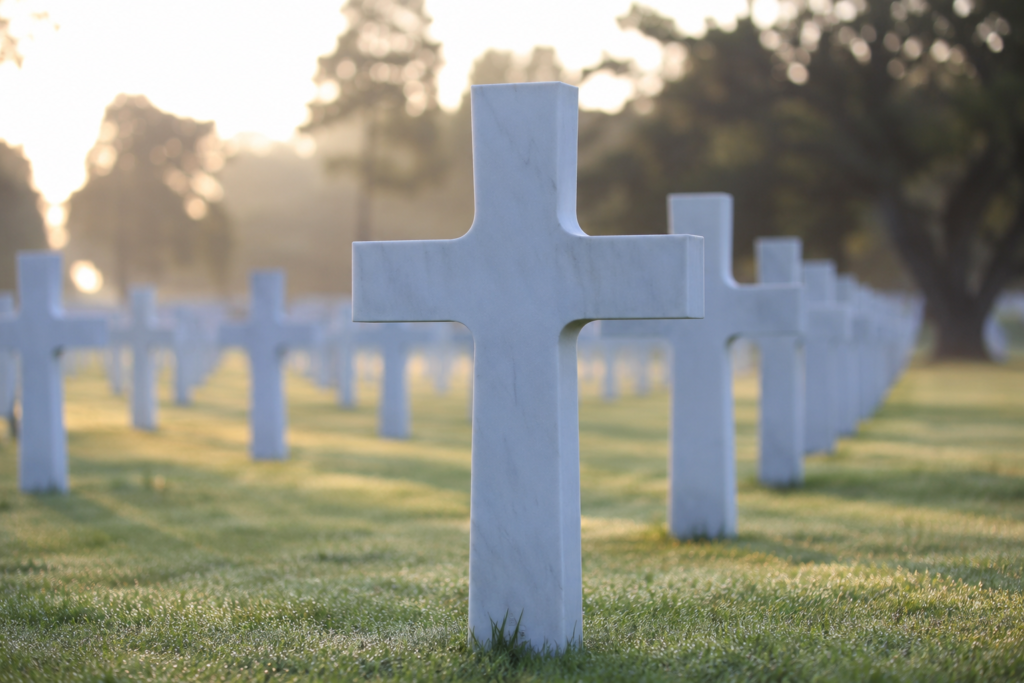
Few places in Normandy stop you in your tracks quite like the American Cemetery at Colleville-sur-Mer. You arrive through pine trees and manicured paths, and then the view opens up: nearly ten thousand white marble headstones in perfect rows, set on a bluff directly above Omaha Beach — the very sand where so many of the men buried here fell on 6 June 1944.

If you’re planning a D-Day itinerary, this is the site most visitors name as the emotional centre of the trip. It’s also one of the easiest major sites to visit well, provided you know what to expect. This guide covers everything you need: what you’ll see, how long to allow, opening times, how to get there, and how to combine it with the rest of the D-Day beaches.
A Brief History
The Normandy American Cemetery is the resting place of 9,387 American servicemen and women, most of whom died during the D-Day landings and the subsequent Battle of Normandy in the summer of 1944. It sits on land granted in perpetuity to the United States by France, and it’s maintained by the American Battle Monuments Commission — which is why, the moment you pass through the entrance, everything from the signage to the flag ceremonies feels distinctly American.
The site was chosen deliberately. It stands directly above Omaha Beach, the bloodiest of the five landing beaches, where American forces suffered thousands of casualties in a single morning. A temporary battlefield cemetery was established just days after the landings; the permanent cemetery you see today was dedicated in 1956.
Free Download
The WWI Battlefield Visitor Checklist
Everything to see, pack, and plan before you visit the Western Front — straight to your inbox.
No spam — just battlefield travel guides. Unsubscribe any time.
Among those buried here are Brigadier General Theodore Roosevelt Jr. — son of the president, and the oldest man to land in the first wave on D-Day, for which he received the Medal of Honor — and two of the Niland brothers, whose story helped inspire Saving Private Ryan. The film’s famous opening and closing scenes were set here, and you’ll almost certainly recognise the setting when you arrive.
What to See
Allow at least two hours to do the site justice — longer if you want to walk down to the beach itself.
The Visitor Centre. Start here. Opened in 2007, the centre sets the human context brilliantly, telling the story of the invasion through the personal accounts of individual soldiers rather than sweeping strategy maps. It’s free, well-designed, and the best possible preparation for what you’ll see outside. Allow 45 minutes to an hour.
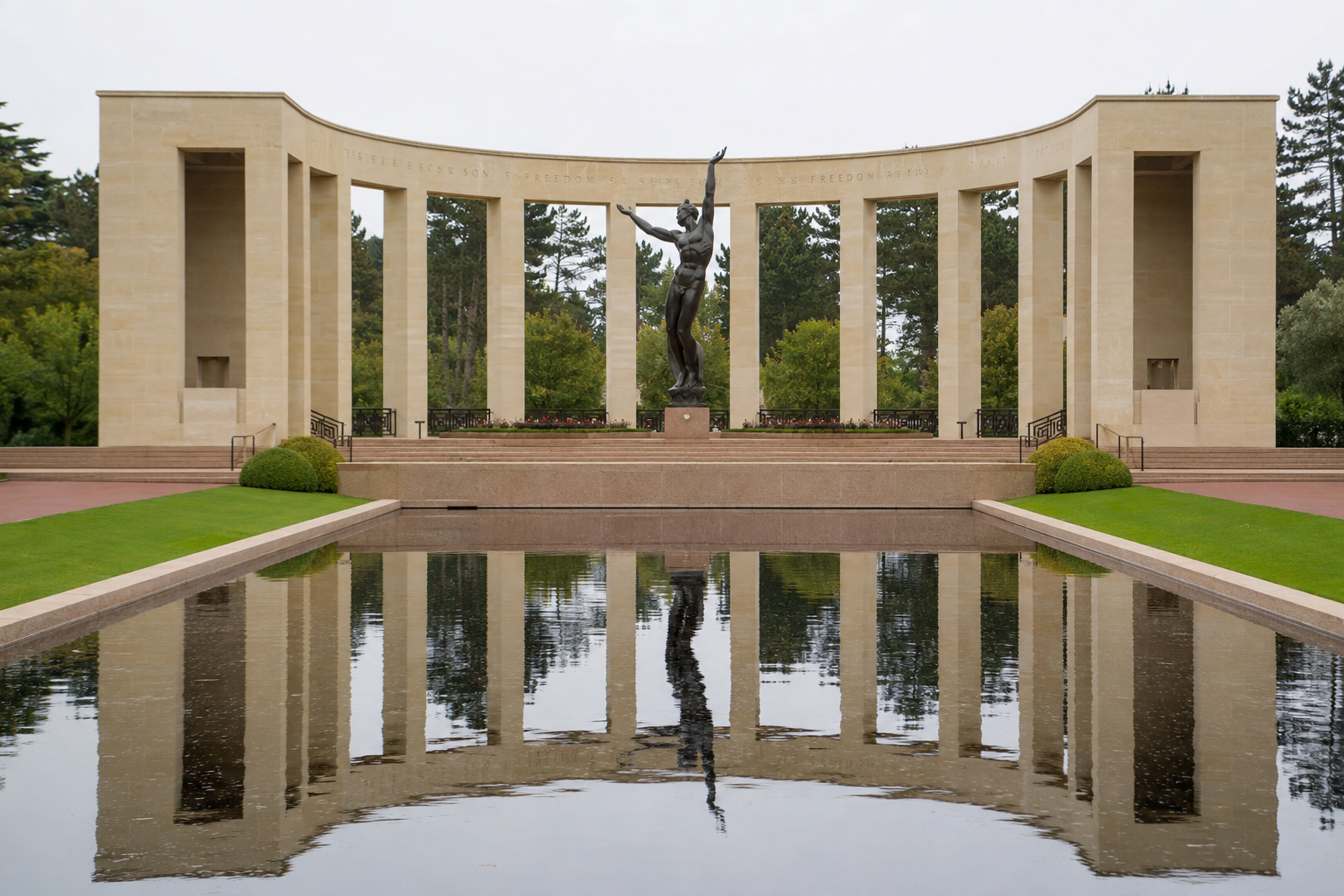
The Memorial and Reflecting Pool. The semicircular memorial colonnade houses a 22-foot bronze statue, The Spirit of American Youth Rising from the Waves, flanked by huge battle maps of the Normandy campaign engraved on the loggia walls. The long reflecting pool stretches from the memorial towards the graves.

The Walls of the Missing. In the garden behind the memorial, the names of 1,557 Americans missing in action are inscribed on a curved wall. Bronze rosettes mark the names of those whose remains were later recovered and identified — a small, quietly moving detail that most visitors walk past without noticing.
The Graves Area. The headstones — Latin crosses and Stars of David in Lasa marble — face west, towards the United States. Take time to walk among them rather than viewing from the paths. Read the names, ages, home states, and dates. It’s the individual details, not the scale, that stay with you.
The Chapel. A small circular chapel stands at the centre of the graves area, with a mosaic ceiling depicting America blessing her sons as they depart, and France laying a wreath on their graves.
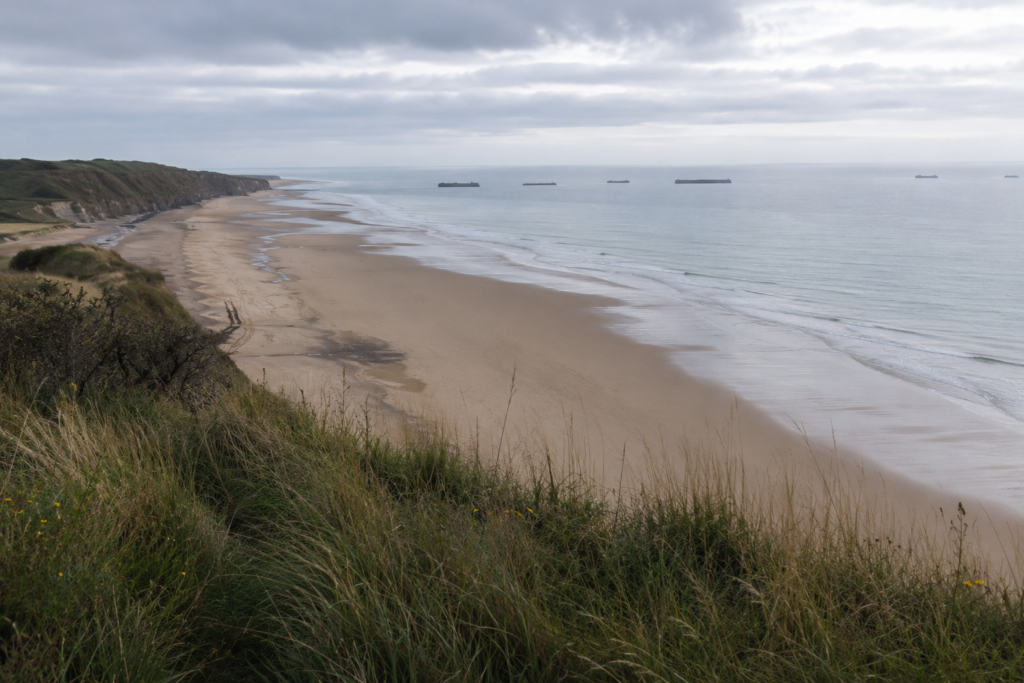
The Omaha Beach Overlook. At the northern edge of the cemetery, an orientation table looks directly down onto Omaha Beach. From here, a path (seasonal, and occasionally closed) leads down through the bluffs to the sand. Standing on the beach and looking back up at the German defensive positions is the single most effective way to understand what the first waves faced.
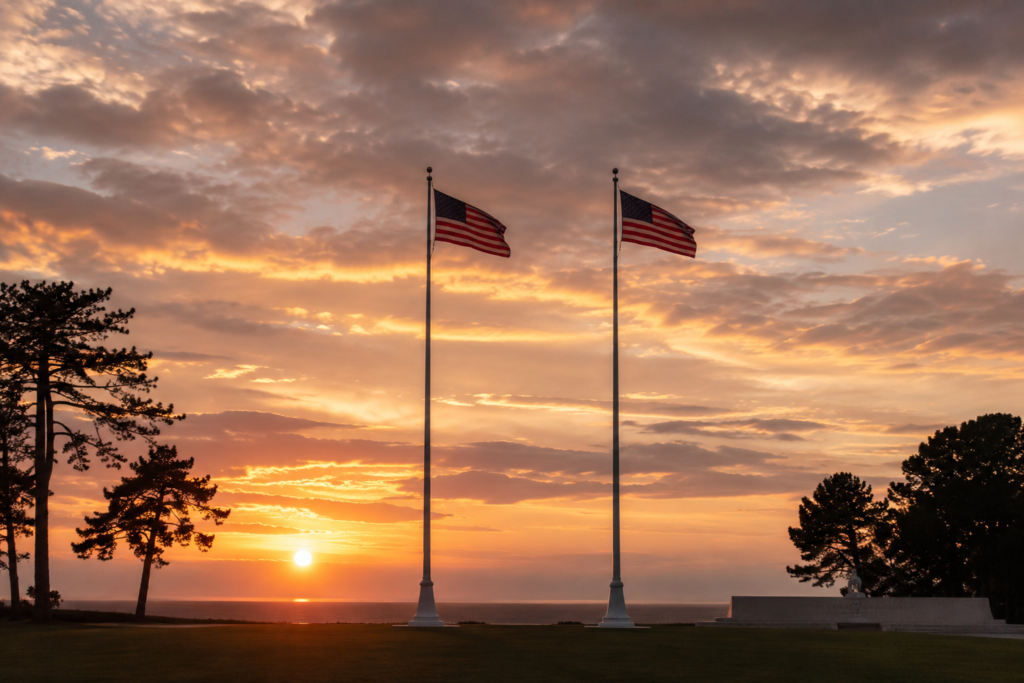
The Flag Ceremony. If you can, time your visit for the lowering of the flags shortly before closing. Taps is played, the two flags are lowered and folded, and the whole cemetery falls silent. It’s simple, brief, and unforgettable.
Practical Information
Opening times: The cemetery is open daily, typically 9:00am–5:00pm (with extended hours to 6:00pm in summer). It closes only on Christmas Day and New Year’s Day. Check the American Battle Monuments Commission website before you travel, as hours and security arrangements can change — particularly around the D-Day anniversary in early June.
Admission: Free. Note that security screening operates at the entrance, so leave large bags in the car.
Facilities: Free parking, toilets, and the visitor centre are all on site. There’s no café, so plan lunch in nearby Bayeux or one of the coastal villages.
Accessibility: The main paths, memorial, and visitor centre are wheelchair accessible. The path down to Omaha Beach is not.
Etiquette: This is an active place of remembrance, and many visitors are relatives of the fallen. Keep voices low, keep children close in the graves area, and don’t picnic on site. Photography is welcome and expected — but be thoughtful about posing for photos among the headstones.
How to Get There
The cemetery is at Colleville-sur-Mer, on the Calvados coast about 30 minutes’ drive northwest of Bayeux and roughly 50 minutes from Caen.
By car is by far the easiest option, and the one I’d recommend if you’re planning to see several D-Day sites. The cemetery is well signposted from the N13, and combining it with Pointe du Hoc (15 minutes further west) and the Omaha Beach memorials at Saint-Laurent-sur-Mer makes a natural half-day circuit.
By guided tour is the best option if you’re not driving. Full-day D-Day tours from Bayeux — and even day trips from Paris — almost all include the American Cemetery alongside Omaha Beach and Pointe du Hoc, and a good guide transforms the visit. (Affiliate placement: link to GetYourGuide and Viator D-Day tours from Bayeux here.)
By public transport is possible but limited: Nomad bus routes run from Bayeux towards the coast in season, but timetables are sparse. If you’re relying on public transport, a tour is honestly the better use of your time and money.
Where to Stay Nearby
Bayeux is the ideal base — a lovely, largely unbombed medieval town within half an hour of all the major American sector sites, with a good range of hotels and restaurants. For something closer, the villages around Colleville-sur-Mer and Port-en-Bessin offer rural B&Bs and gîtes with sea air and silence.
Combining Your Visit
The American Cemetery sits at the heart of the American sector, so it pairs naturally with:
- Omaha Beach — directly below the cemetery; visit the Les Braves sculpture at Saint-Laurent-sur-Mer
- Pointe du Hoc — the clifftop Ranger assault site, 15 minutes west, still cratered from the naval bombardment
- The Overlord Museum — right beside the cemetery entrance, with an impressive vehicle collection
- Utah Beach — around 45 minutes west, with an excellent museum
For the full picture of the landings, see our complete guide to visiting the D-Day beaches in Normandy
Final Thoughts
You could see the American Cemetery in an hour, ticked off between other sites. Don’t. Give it a slow morning or a late afternoon, walk to the overlook, go down to the beach if the path is open, and stay for the flags if you can. Of all the places along this coast, this is the one that turns the statistics of D-Day back into people — and that, in the end, is why we make these journeys at all.