The Evolution of Military Tactics in Europe: From Ancient Battlegrounds to the Modern Era
Military tactics have shaped the course of European history more profoundly than perhaps any other force. From the narrow pass at Thermopylae to the blood-soaked trenches of the Somme, the continent has been both the stage and the crucible for warfare’s most dramatic transformations. This guide explores how military thinking evolved across the ages — and what that means for the history traveller standing on these legendary battlegrounds today.
Ancient Warfare: Greece, Rome, and the Birth of Western Military Thinking
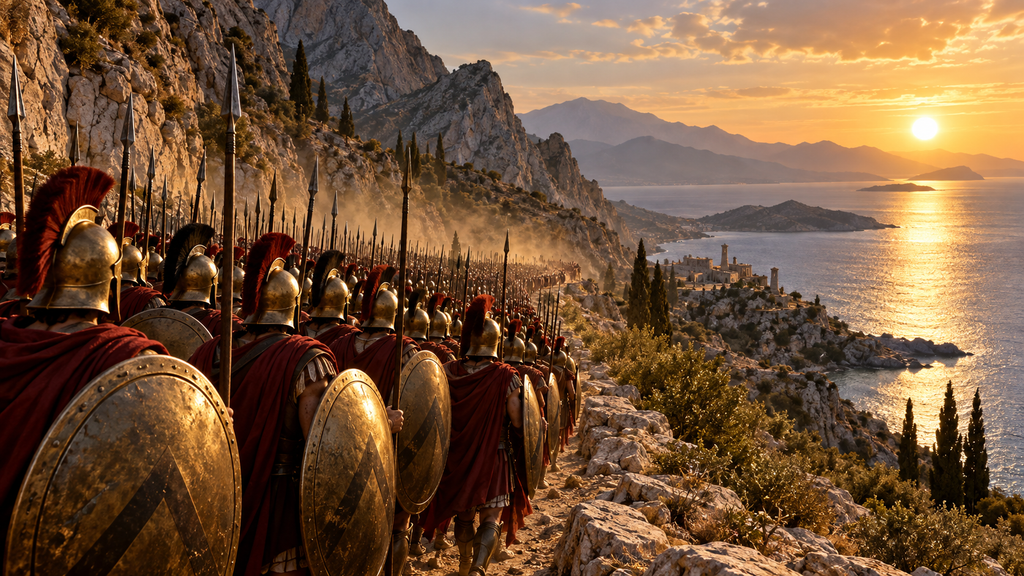
The ancient world gave Europe its foundational military vocabulary. No battle captures this more vividly than the Battle of Thermopylae in 480 BCE, where a small Greek force — famously including three hundred Spartans under King Leonidas — held a narrow coastal pass against the vast Persian army of Xerxes I.
The Greeks’ tactical genius lay in terrain selection. By fighting in the pass, they negated the Persians’ overwhelming numerical advantage and rendered cavalry useless. The Greek hoplite phalanx — a tightly packed wall of overlapping shields and extended spears — proved devastating in confined spaces. Although the Greeks were eventually outflanked and destroyed, their stand delayed the Persian advance and became one of history’s most enduring military lessons: ground chosen wisely can equalise even the most unequal contest.
The site at Thermopylae in central Greece remains visitable today, with a modern monument to Leonidas standing near the original pass.
Free Download
The WWI Battlefield Visitor Checklist
Everything to see, pack, and plan before you visit the Western Front — straight to your inbox.
No spam — just battlefield travel guides. Unsubscribe any time.
The Romans took these lessons further, developing the manipular legion — a flexible, adaptable formation that replaced the rigid phalanx and allowed Roman armies to fight effectively across varied terrain. Rome’s military machine conquered much of Europe, leaving behind a trail of battlefield sites, fortifications, and memorials that still punctuate the landscape from Britain to the Balkans.
Medieval Warfare: Knights, Archers, and the Revolution at Agincourt
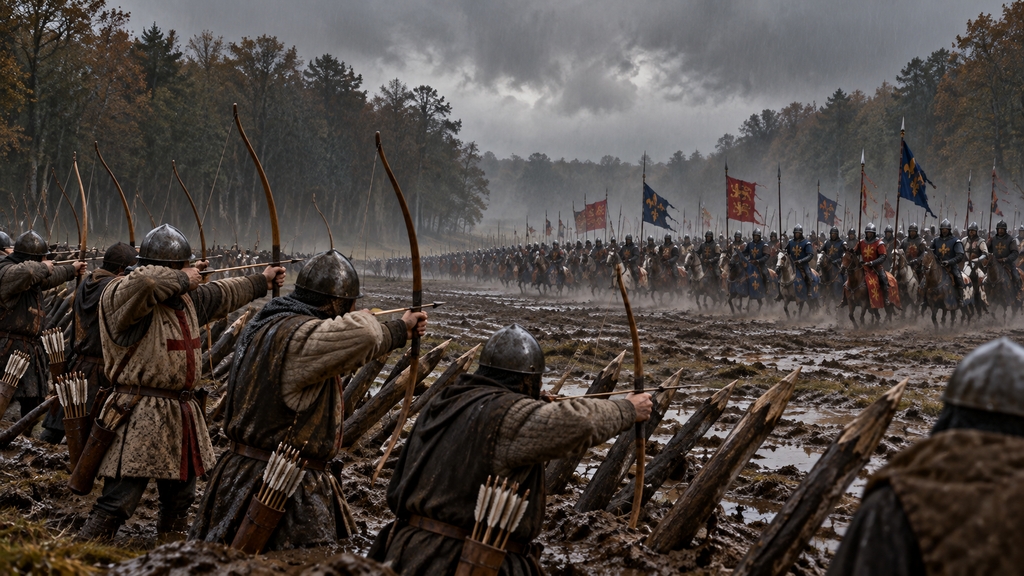
The medieval period brought heavy cavalry to the centre of European warfare. Armoured knights on horseback represented the dominant military technology of their age — expensive, prestigious, and seemingly unstoppable.
The Battle of Hastings in 1066 illustrates the transition between eras. Harold Godwinson’s Anglo-Saxon forces relied on the traditional shield wall — a dense, interlocked line of infantry that had served English armies well for centuries. William the Conqueror’s Norman army countered with a more sophisticated combined approach, using archers to soften the shield wall before committing his cavalry. When the Normans feigned retreat and lured the Anglo-Saxons out of formation, the battle was decided. The site of the battle, at what is now Battle Abbey in East Sussex, is one of England’s most atmospheric heritage sites — you can walk the very ground where Harold fell.
By the 15th century, the dominance of heavy cavalry was under serious challenge. At the Battle of Agincourt in 1415, an English army under Henry V faced a French force that outnumbered it significantly. Henry positioned his longbowmen on a narrow, wood-flanked field that funnelled the French cavalry into a killing ground. The heavily armoured French knights — many dismounted and advancing on foot through churned mud — were cut down by waves of English arrows before they could close.
Agincourt demonstrated a truth that would echo through military history: expensive, prestigious technology is useless if the tactical conditions work against it. The battlefield at Azincourt in northern France is still largely rural and undeveloped, making it one of Europe’s most evocative medieval battle sites.
The Early Modern Period: Gunpowder, Flexibility, and the Thirty Years’ War
The introduction of firearms transformed European warfare in ways that took over a century to fully digest. The Battle of Breitenfeld in 1631, fought during the Thirty Years’ War, marks one of the clearest turning points.
The Swedish king Gustavus Adolphus arrived with an army built around radical new ideas. Rather than the large, slow Spanish tercio formations — blocks of pike and musket thousands strong — he deployed smaller, faster units that could manoeuvre independently and support each other across a wide front. He also integrated cavalry, infantry, and artillery far more fluidly than his opponents. The result was a crushing Swedish victory and the effective birth of combined-arms warfare as a systematic doctrine.
A generation later, the Battle of Blenheim in 1704 — fought near the Bavarian village of Blindheim during the War of the Spanish Succession — showed how far operational thinking had developed. The Duke of Marlborough and Prince Eugene of Savoy coordinated British and Austrian forces across a broad front, using a diversionary attack to fix French and Bavarian troops in place before striking the weakened centre. It was precisely the kind of complex, multi-axis operation that required not just tactical skill but strategic vision — and it remains one of the most celebrated victories in British military history.
The Napoleonic Era: Speed, Manoeuvre, and the Emperor’s Art
No period transformed European warfare more comprehensively than the Napoleonic era. Napoleon Bonaparte did not merely fight battles well — he reconceived how armies could move, concentrate, and strike.
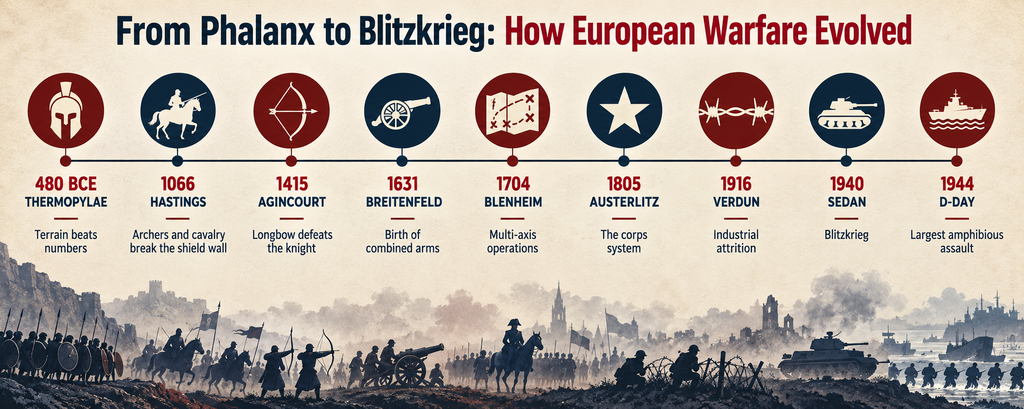
His masterpiece, the Battle of Austerlitz on 2 December 1805, is still studied in military academies worldwide. Facing a larger Russo-Austrian army in Moravia (modern Czech Republic), Napoleon deliberately weakened his own right flank to tempt the Allies into attacking it. As they committed their best troops to that assault, they thinned their centre. Napoleon then launched his guards and reserves directly through that weakened point, splitting the Allied army in two. It was over in hours.
The battle demonstrated Napoleon’s central innovation: the corps d’armée system, in which large, self-sufficient combined-arms formations could march independently and converge on a battlefield from multiple directions, concentrating overwhelming force at the decisive moment.
Yet Waterloo, on 18 June 1815, showed the limits of even genius. Wellington’s British and Allied army fought a masterclass in defensive warfare — positioning troops on the reverse slopes of ridges to protect them from French artillery, absorbing repeated assaults through disciplined fire, and holding long enough for the Prussian army under Blücher to arrive. When the Prussians struck Napoleon’s flank, the French army disintegrated.
The Waterloo battlefield in Belgium is among the most visited military history sites in Europe, with the famous Lion’s Mound, the Hougoumont farmhouse, and the Memorial 1815 museum all within walking distance of one another. It is, simply, essential ground for any serious military history traveller.
World War I: The Western Front and the Industrialisation of Death
The First World War represents the most catastrophic collision between 19th-century military thinking and 20th-century industrial technology. Generals trained in the era of cavalry charges and decisive offensive battles found themselves commanding millions of men against machine guns, barbed wire, and artillery barrages of previously unimaginable scale.
The Battle of Verdun in 1916 captures the horror of this mismatch. The German strategic plan was deliberately attritional — to draw the French army into a killing ground and destroy it through sheer firepower. The French, under General Pétain, refused to yield ground of national symbolic importance. The result was ten months of continuous fighting, nearly a million casualties combined, and a landscape so devastated that parts of the Zone Rouge around Verdun remain uninhabitable today due to unexploded ordnance and chemical contamination.
Yet the Western Front also generated innovation. By 1917 and 1918, British, French, and German armies had developed sophisticated new approaches: the creeping barrage (artillery fire advancing just ahead of infantry), stormtrooper infiltration tactics (small units bypassing strongpoints rather than attacking them frontally), and the integration of tanks, aircraft, and infantry that would become the template for Second World War operations.
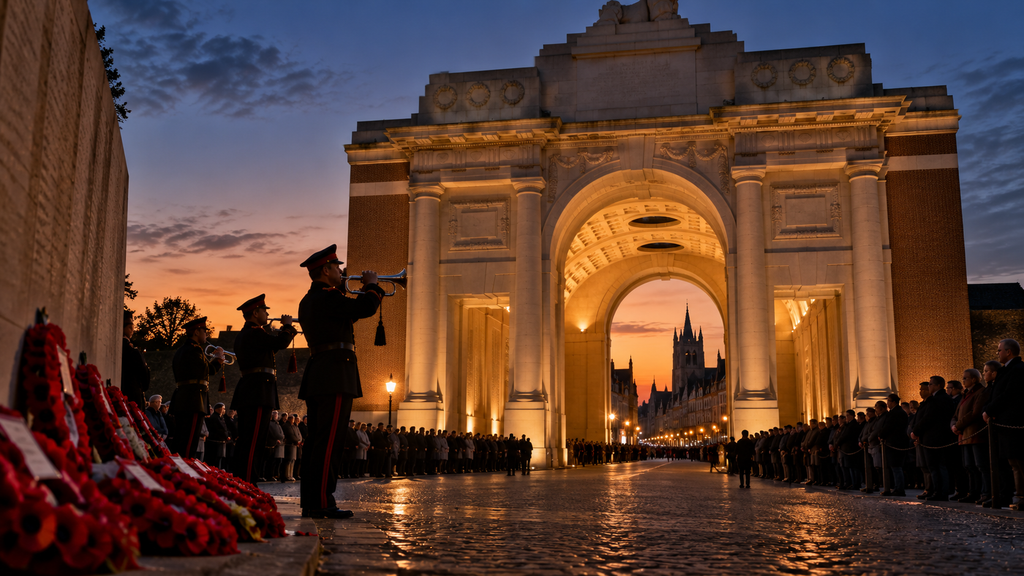
The legacy of the Western Front is written into the landscape of France and Belgium. Ypres (Ieper) in Belgium — the site of three major battles — remains one of the most moving destinations in military history travel. Every evening at eight o’clock, the Last Post is sounded beneath the Menin Gate, as it has been almost without interruption since 1928. The Tyne Cot Cemetery, the largest Commonwealth war cemetery in the world, lies just a short drive away. Further south, the Somme and Verdun battlefields are now peaceful farmland punctuated by cemeteries, memorials, and craters — landscapes that repay careful, unhurried exploration.
World War II: Blitzkrieg, D-Day, and the Liberation of Europe
The Second World War saw a return to mobile warfare on a continental scale, driven by the German doctrine of Blitzkrieg — the concentrated use of armour, motorised infantry, and ground-attack aircraft to rupture enemy lines and collapse command structures before a coherent defence could form.
The fall of France in 1940, achieved in just six weeks against an Allied army that was numerically comparable to Germany’s, shocked the world and remains one of military history’s most studied campaigns. The German breakthrough at Sedan — exploiting the ‘weak’ point in the Ardennes that Allied planners had assumed impassable to armour — was a supreme example of identifying and attacking an opponent’s unstated assumption.
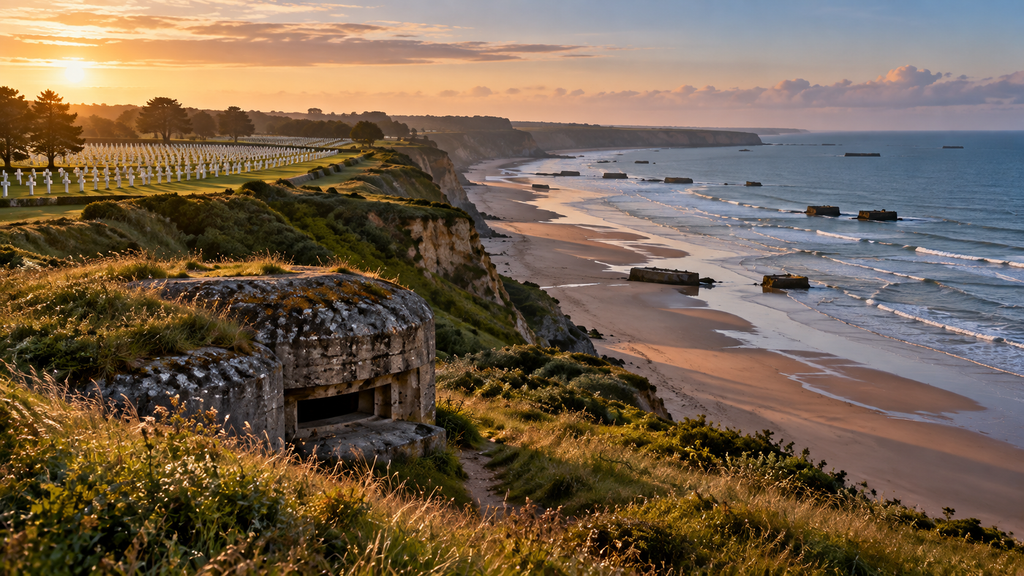
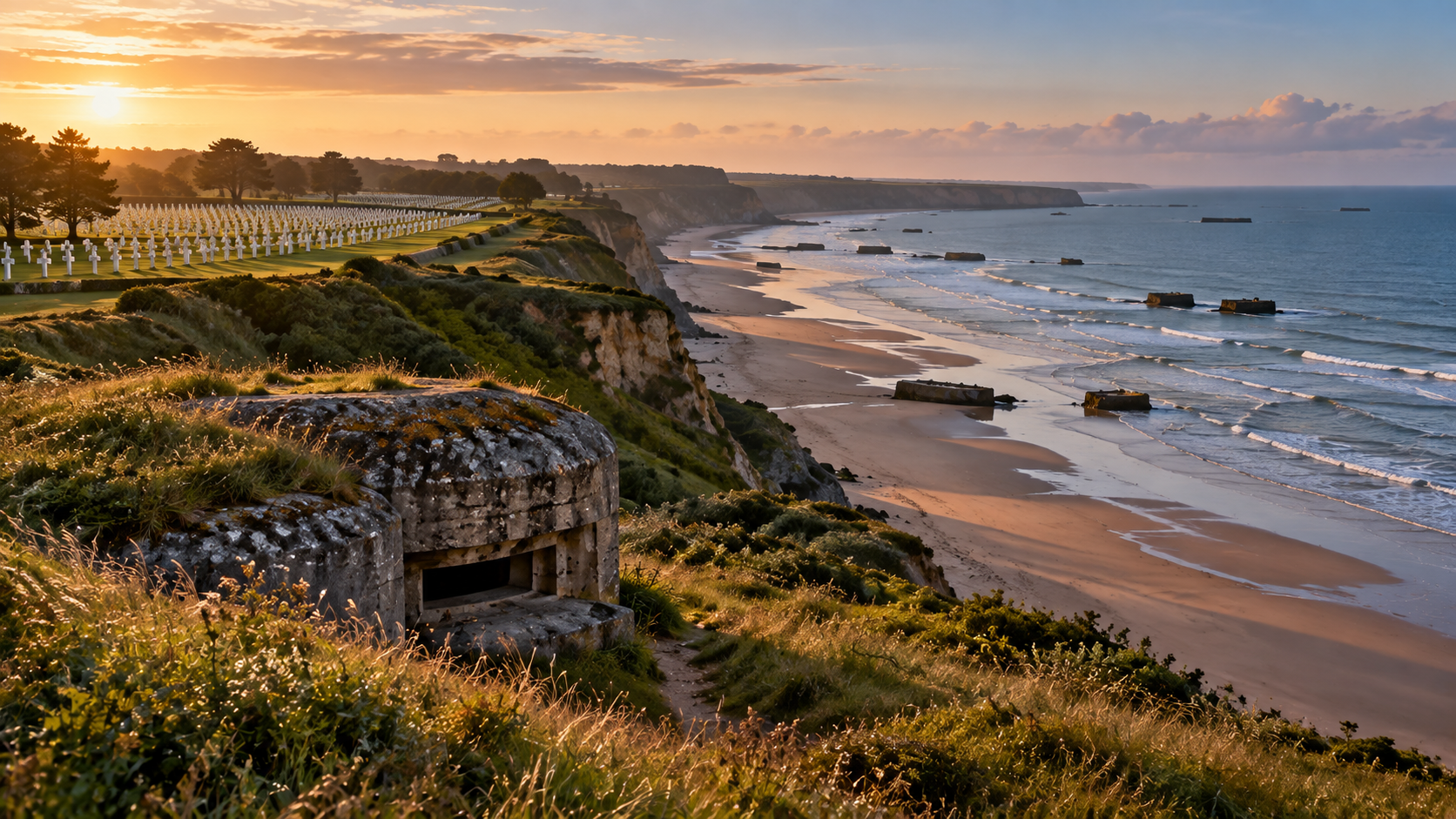
The D-Day landings on 6 June 1944 represent the most complex amphibious operation in history and the moment when the liberation of Western Europe began in earnest. Five Allied armies landed simultaneously across five Normandy beaches — Utah, Omaha, Gold, Juno, and Sword — supported by airborne drops inland and an unprecedented naval bombardment. The cost was enormous, particularly at Omaha Beach, where American forces faced the most heavily defended position and suffered catastrophic initial casualties before establishing a foothold.
Normandy today is the single most visited battlefield destination in Europe. The American Cemetery at Colleville-sur-Mer, overlooking Omaha Beach, receives over a million visitors annually. The Mémorial de Caen provides the finest museum overview of the entire campaign. The beaches themselves, the bunkers at Pointe du Hoc, and the airborne sites around Sainte-Mère-Église can all be explored independently — though guided tours, which offer historical context that dramatically deepens the experience, are available from Bayeux and Caen.
The later stages of the European campaign saw fierce fighting in the Netherlands, at Arnhem (Operation Market Garden, September 1944) and across the Rhine into Germany itself. Monte Cassino in Italy — where Allied forces fought for months to dislodge a German defensive line — stands as one of the hardest-won victories of the entire war.
Visiting Europe’s Military History: Where to Begin
For those planning their first military history journey through Europe, the richness of choice can be overwhelming. A few suggestions for where to start:
For WWI: Begin in Ypres (Ieper), Belgium — compact, deeply moving, and with some of the finest museum infrastructure in the world. The Last Post ceremony at the Menin Gate is unmissable.
For WWII: The Normandy coast is the obvious starting point, with an extraordinary concentration of sites, museums, and memorials within a small area. A long weekend from the UK via ferry from Portsmouth or Poole gives enough time to do justice to the beaches and the inland airborne sites.
For ancient and medieval battles: Battle Abbey in East Sussex is an easy day trip from London. Waterloo in Belgium is accessible from Brussels in under an hour and rewards a full day’s exploration. The battlefields of Thermopylae and Marathon in Greece offer a more adventurous itinerary for those drawn to the ancient world.
For WWI and WWII together: A road trip through northern France and Belgium, from the Somme through the Ypres Salient to Normandy, offers one of the most profound travel experiences in Europe — and one that remains, for many visitors, genuinely life-changing.
Europe’s battlegrounds are not simply sites of death and destruction — they are places where the course of history turned, where individuals faced impossible choices, and where the values that define modern European civilisation were tested to their limits. To stand on these fields is to understand history not as dates and statistics, but as lived human experience.
More from Battleground History: