Pointe du Hoc: The Ranger Assault That Changed History
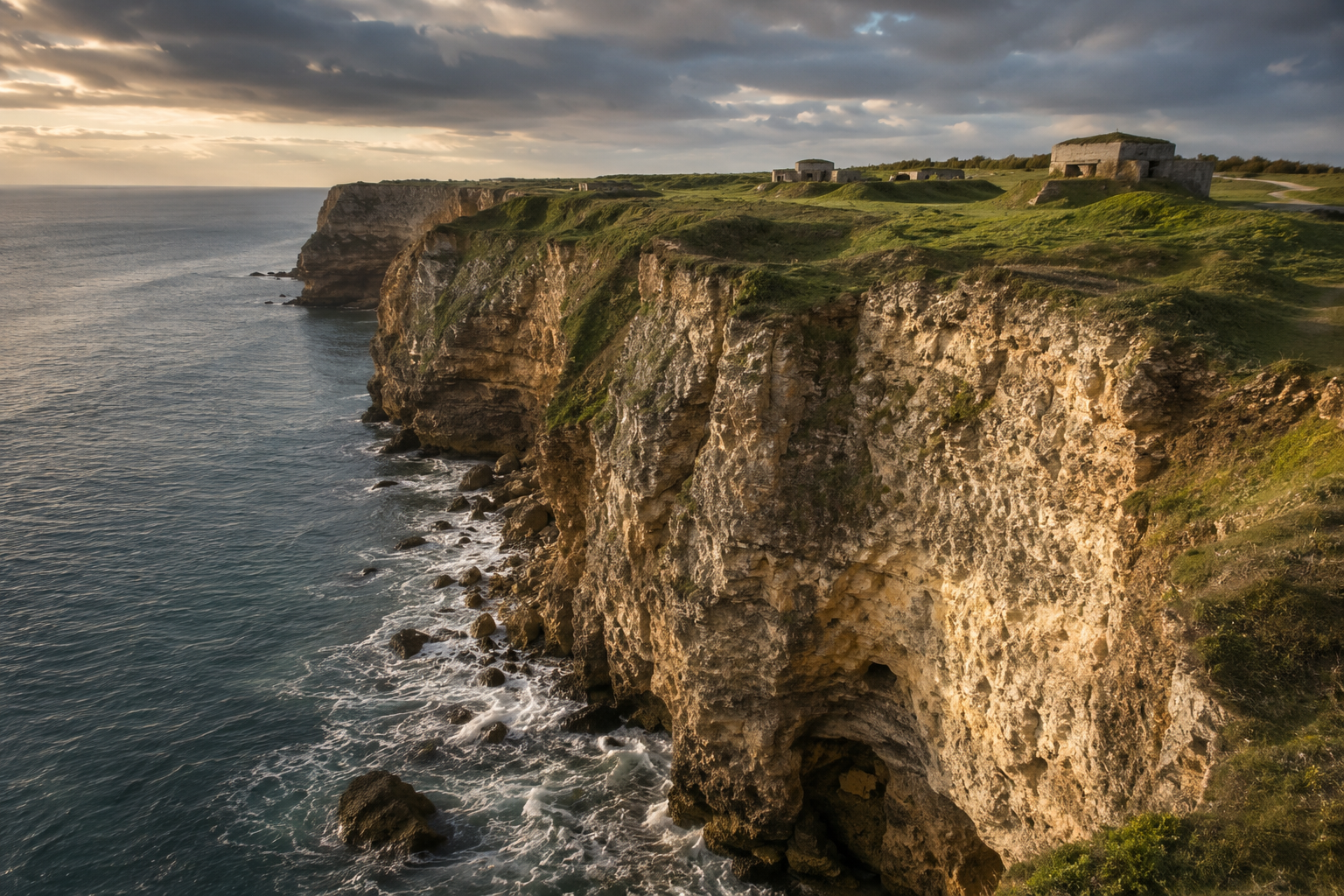
Stand on the clifftop at Pointe du Hoc on a quiet morning and it’s hard to believe anyone thought this could be done. The cliffs drop 30 metres — roughly the height of a ten-storey building — straight into the English Channel. The rock is sheer, crumbling in places, and in June 1944 it was defended by German troops firing down on anyone foolish enough to try to climb it.

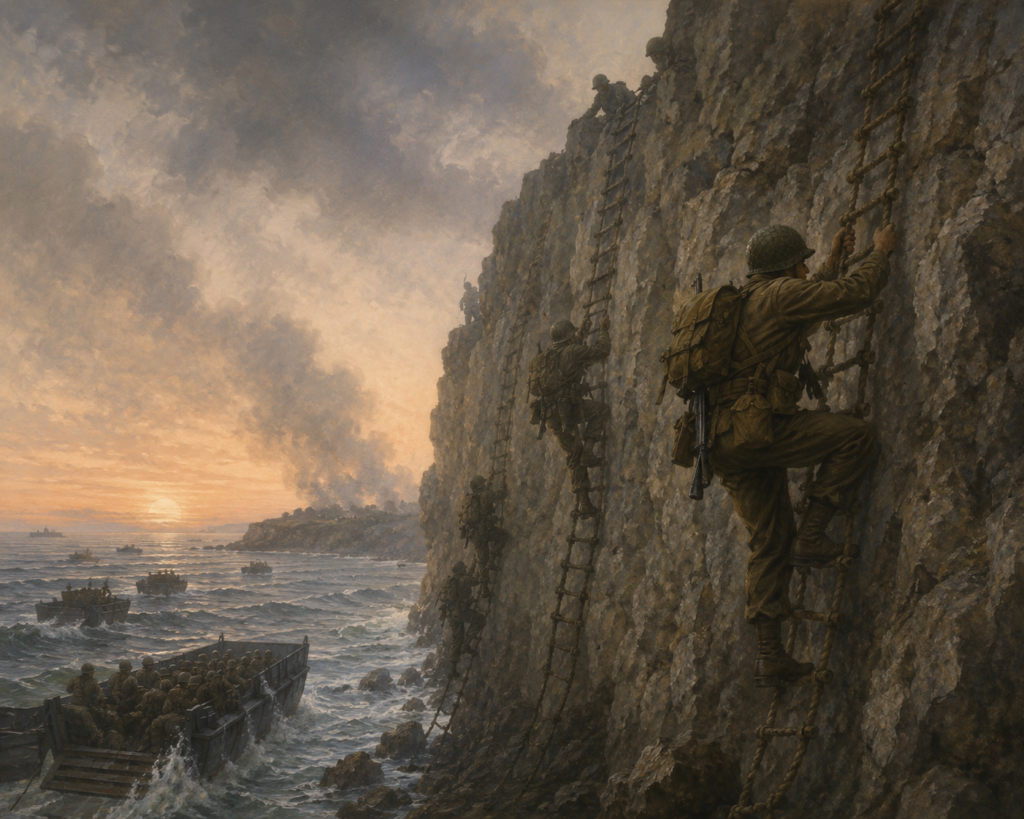
And yet, at first light on D-Day, around 225 men of the US 2nd Ranger Battalion did exactly that. They crossed a churning sea under fire, fired rocket-propelled grappling hooks up the cliff face, and climbed rope ladders while grenades dropped around them. What they found at the top — and what they did over the next two days — has become one of the defining stories of the Normandy landings.
Today, Pointe du Hoc is one of the most powerful places you can visit on the entire D-Day coast, and unlike some Normandy sites it remains almost exactly as the battle left it. This guide covers the history, what you’ll see when visiting Pointe du Hoc today, and everything you need to plan your trip.
This article is part of our Complete Guide to Visiting the D-Day Beaches in Normandy — start there if you’re planning a full Normandy itinerary.
Free Download
The WWI Battlefield Visitor Checklist
Everything to see, pack, and plan before you visit the Western Front — straight to your inbox.
No spam — just battlefield travel guides. Unsubscribe any time.
Why Pointe du Hoc Mattered
Look at a map of the Normandy landing beaches and Pointe du Hoc sits in a chilling position: a fortified headland jutting into the Channel almost exactly between Utah Beach to the west and Omaha Beach to the east.
Allied intelligence believed the Germans had installed a battery of six 155mm guns here — heavy artillery with the range to hammer both American beaches and the invasion fleet offshore. If those guns were firing on the morning of 6 June, the landings at Utah and Omaha could become a massacre before they had properly begun.
Bombing alone couldn’t guarantee the guns’ destruction. The battery had been pounded from the air for weeks, but the casemates were thick concrete and the only way to be certain was to put men on the ground. The problem was obvious: the position sat atop cliffs the Germans considered unclimbable, which was precisely why they had left them relatively lightly defended from the seaward side.
The task fell to the 2nd Ranger Battalion under Lieutenant Colonel James Earl Rudder, a 34-year-old Texan who would lead the assault personally. When one staff officer saw the plan, he reportedly dismissed it as impossible — three old women with brooms, he suggested, could sweep the Rangers off the cliff. Rudder’s men were about to prove otherwise.
The Assault: Dawn, 6 June 1944
Things went wrong almost immediately, as they so often did on D-Day. A navigation error sent the Rangers’ landing craft towards the wrong headland, and by the time the mistake was corrected they were nearly 40 minutes behind schedule, approaching the cliffs in daylight with the element of surprise fading fast. One supply craft swamped and sank. Men bailed water out of the surviving boats with their helmets.
When the Rangers finally hit the narrow shingle beach at the base of the cliffs, they came under fire from above. They launched their rocket-fired grappling hooks — some of the ropes, soaked with seawater, were too heavy to reach the top — and began to climb. Germans at the cliff edge cut ropes and dropped grenades. The Rangers kept climbing. Some went up hand over hand on bare rock where the ropes failed. Naval gunfire from the destroyers USS Satterlee and HMS Talybont raked the cliff edge to keep the defenders’ heads down.
Within about 30 minutes, the first Rangers were over the top and into a landscape from another world: the clifftop had been so heavily bombed that it resembled the surface of the moon, all overlapping craters and shattered concrete.
Then came the twist that makes this story extraordinary. When the Rangers fought their way into the gun casemates, they found them empty. The heavy guns had been moved. In their place stood timber decoys.
A lesser unit might have stopped there. Instead, small Ranger patrols pushed inland, and two men — Sergeants Leonard Lomell and Jack Kuhn — found five of the missing guns hidden in an orchard, camouflaged and pointed towards Utah Beach, with their crews assembled a short distance away. Working quickly and quietly, they destroyed the guns’ firing mechanisms with thermite grenades. The battery that threatened two invasion beaches was silenced before it fired a meaningful shot at the landings.
The Two Days After
The climb was only the beginning. The Rangers then had to hold Pointe du Hoc against repeated German counterattacks, cut off from the main invasion force, short of ammunition, food and water. Relief that was expected within hours took two days to arrive.
By the time troops advancing from Omaha Beach finally linked up with them on 8 June, the cost was stark: of the roughly 225 Rangers who had landed, only around 90 were still able to fight. The rest were dead, wounded or missing.
The action earned the 2nd Ranger Battalion a place in military legend, and the phrase attributed to the Rangers’ spirit that day — that the impossible just takes a little longer — feels entirely earned when you stand where they fought.
What You’ll See at Pointe du Hoc Today
Pointe du Hoc is maintained by the American Battle Monuments Commission (ABMC), the same body that cares for the Normandy American Cemetery, and it is preserved rather than restored. That distinction matters. Where other sites have been tidied, Pointe du Hoc has deliberately been left as the battle shaped it.
The first thing that strikes most visitors is the ground itself. The clifftop is a churned sea of grassed-over bomb craters, some deep enough to swallow a car, running into one another across the whole headland. Walking the paths between them gives you a visceral sense of the weight of bombardment this small patch of France absorbed — something no photograph or documentary quite conveys.
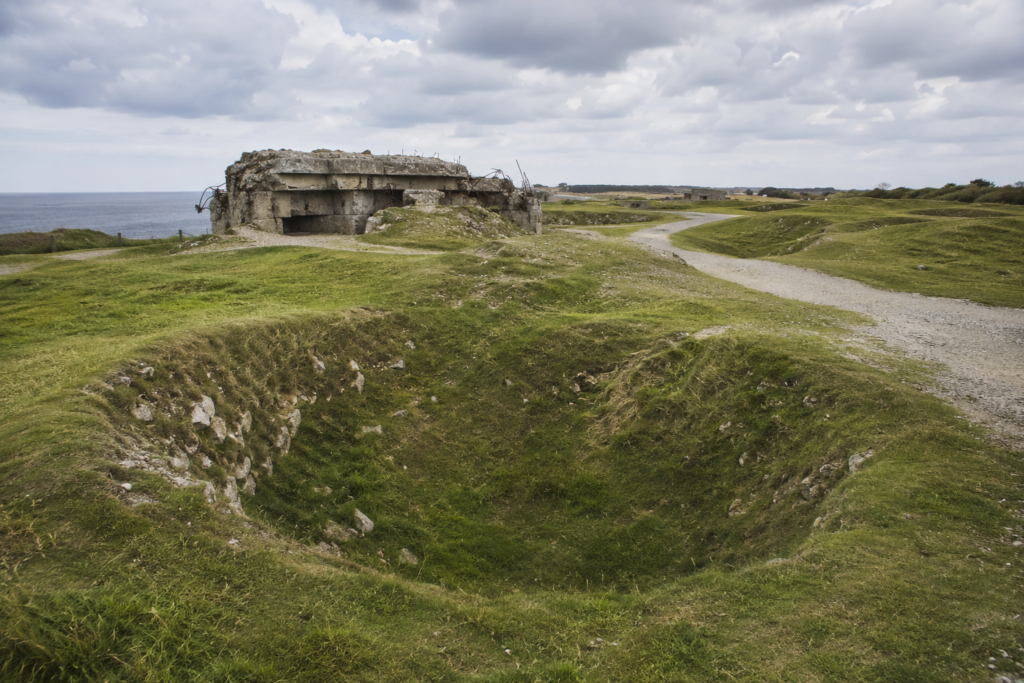
Scattered across the site you’ll find:
- The ruined casemates and gun pits — the massive concrete emplacements built for the 155mm battery, several smashed open by bombing, others intact enough to walk into
- The German observation bunker — perched right on the cliff edge, this was the eyes of the battery and is now the base of the Ranger Monument
- Underground shelters and ammunition stores — some accessible, dark and cool even in summer, where you can stand where the German garrison sheltered during the bombardment
- The cliff edge itself — fenced viewpoints let you look down the same rock face the Rangers climbed, which is worth doing before you read another word about the assault
Allow 1.5 to 2 hours to do the site justice. There is a visitor building near the car park with orientation displays and facilities, and interpretive panels in English and French are placed throughout the site. Note that erosion works and safety fencing occasionally close sections near the cliff edge, so check the ABMC website before you travel if seeing a specific feature matters to you.
The Ranger Monument
At the seaward tip of the site, on top of the German observation bunker, stands the Pointe du Hoc Ranger Monument — a simple granite pylon representing the Ranger dagger, flanked by tablets honouring the men of the 2nd Ranger Battalion.
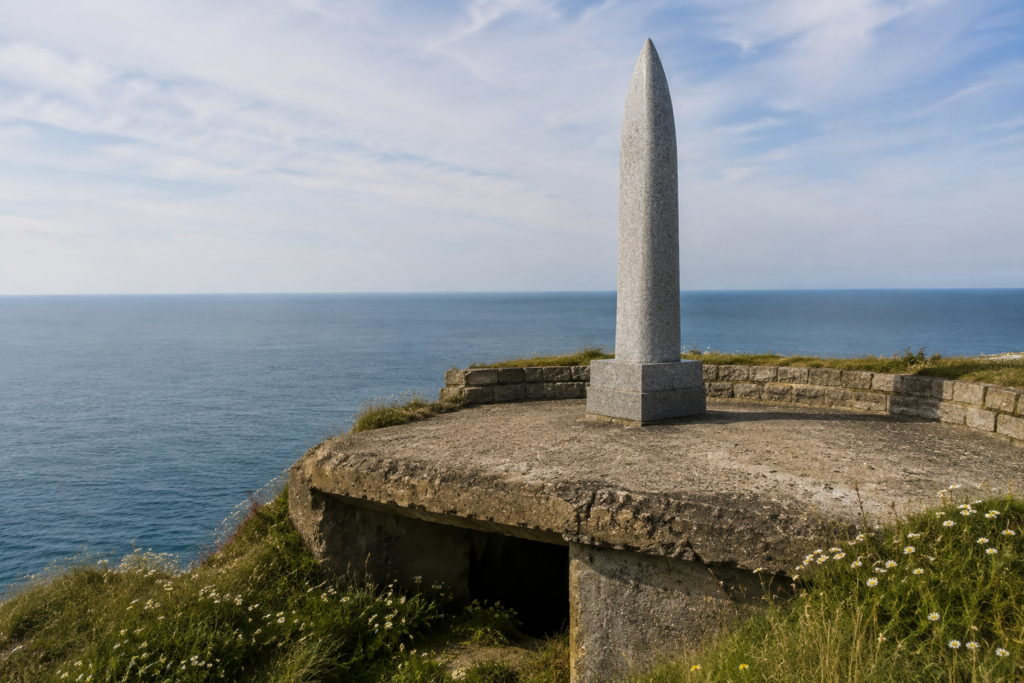
It was here, on the 40th anniversary of D-Day in 1984, that President Ronald Reagan delivered one of the most famous commemorative speeches of the twentieth century to an audience that included surviving Rangers — the veterans he called the boys of Pointe du Hoc. If you watch the speech before your visit (it’s easily found online), standing at the monument becomes a far richer experience. France formally transferred the site to American care in 1979, and it remains one of the most visited D-Day locations in Normandy.
Planning Your Visit to Pointe du Hoc
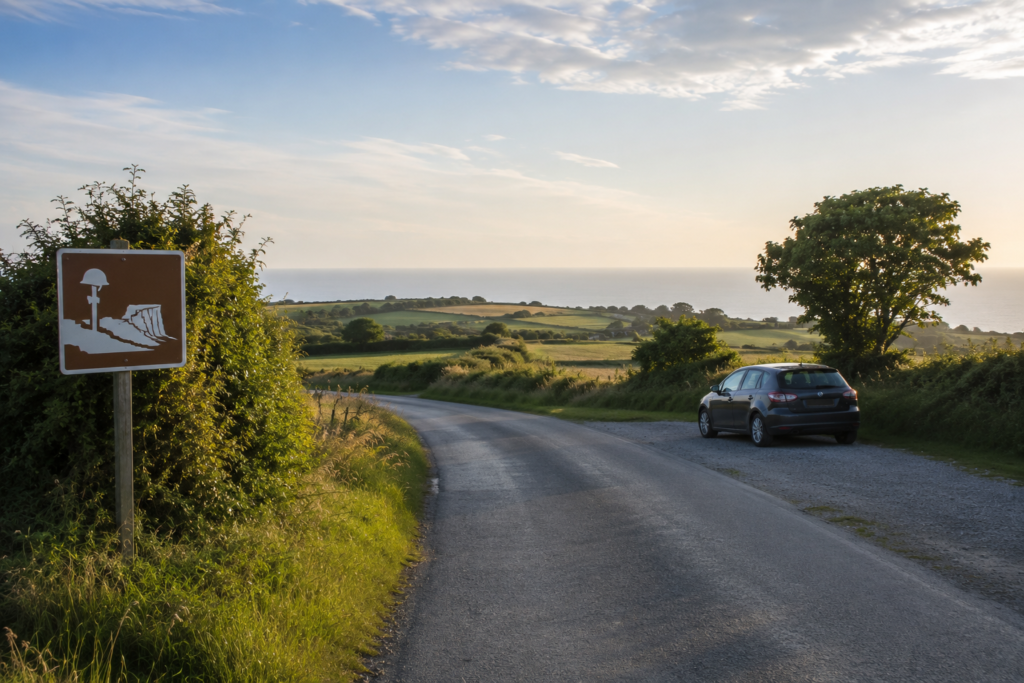
Where it is: Pointe du Hoc sits on the D514 coastal road in the commune of Cricqueville-en-Bessin, about 6.5 km west of Omaha Beach and roughly 40 minutes’ drive from Bayeux. It slots naturally into any D-Day beaches itinerary between the American Cemetery at Colleville-sur-Mer and Utah Beach.
Opening and cost: Entry is free. The grounds are open daily, generally from 9am, with the visitor facilities keeping slightly shorter hours; opening times can vary seasonally, so confirm current hours on the American Battle Monuments Commission website before you go.
Getting there: A car is by far the easiest option — there’s a large free car park at the site. Public transport to Pointe du Hoc itself is very limited, which is one reason guided D-Day tours are so popular. If you’re driving from the UK, the Portsmouth–Caen and Poole–Cherbourg ferries both put you within easy reach of the D-Day coast.
Guided tours: Most full-day D-Day tours from Bayeux and Caen include Pointe du Hoc alongside Omaha Beach and the American Cemetery, and a good guide transforms the site — the tactical detail of the climb and the fight inland is much easier to grasp with someone walking you through it on the ground. (Affiliate placement: GetYourGuide and Viator links for “D-Day beaches tour from Bayeux” here — these are among the highest-converting Normandy products.)
Where to stay: Bayeux is the best base for the American sector — close to the sites, full of restaurants, and home to its own excellent museums. Grandcamp-Maisy, the small fishing port just along the coast, puts you five minutes from Pointe du Hoc if you want to visit at opening time before the coaches arrive. (Affiliate placement: Booking.com links for Bayeux and Grandcamp-Maisy hotels here. Cross-link to “Best Places to Stay in Normandy for Battlefield Visitors” when published.)
When to go: Early morning or late afternoon, outside July and August if you can, for the quietest experience. Expect the site to be extremely busy around the D-Day anniversary on 6 June. The clifftop is exposed — bring a windproof layer even in summer.
Visiting with children: The craters and bunkers genuinely engage children in a way that cemeteries sometimes don’t, but keep younger children close near the cliff edges and in the darker bunkers. (Cross-link to “Visiting WWI Battlefields with Family” / future family D-Day content.)
Tips for a More Meaningful Visit
- Look down the cliff first. Before exploring the bunkers, walk to the fenced viewpoint and look down the rock face. Everything else at the site makes more sense once you’ve seen what the Rangers actually climbed.
- Read up on Lomell and Kuhn. Knowing the story of the two sergeants who found and disabled the guns turns an inland stretch of the site from “more craters” into the climax of the battle.
- Watch Reagan’s 1984 speech beforehand. Ten minutes online before you travel adds enormous depth to the monument.
- Combine it thoughtfully. Pointe du Hoc pairs naturally with Omaha Beach and the Normandy American Cemetery for a full and emotionally coherent day in the American sector.
- Go early. The site is at its most atmospheric — and most photogenic — before mid-morning, when the tour coaches begin to arrive.
Final Thoughts
Plenty of D-Day sites tell you what happened. Pointe du Hoc shows you. The craters, the smashed concrete, the sheer drop to the Channel — the landscape itself does the storytelling, and it does it with a force that catches even seasoned battlefield visitors off guard.
If your Normandy itinerary only has room for three stops, make this one of them. And if you’re building a longer trip along the invasion coast, our [Complete Guide to Visiting the D-Day Beaches in Normandy] will help you piece the whole story together, from Utah Beach to Pegasus Bridge.
Recommended pre-trip reading: The Boys of Pointe du Hoc by Douglas Brinkley, and Stephen Ambrose’s D-Day. (Affiliate placement: Amazon Associates / Hive.co.uk links here.)