Passchendaele (Third Battle of Ypres): What to See and Where to Stay
A complete visitor’s guide to one of the Western Front’s most haunting and significant battle sites, from the Tyne Cot Cemetery to the Passchendaele Museum — and where to base yourself for a meaningful trip.
| Location | Passendale (Passchendaele), West Flanders, Belgium |
| Nearest city | Ypres (Ieper) — approximately 10 km south-west |
| Battle dates | 31 July – 10 November 1917 |
| Casualties | Approx. 275,000 Allied and 220,000 German |
| Best time to visit | April–October (July–August is peak season) |
| Getting there | Fly to Brussels or Lille, then drive or take a train to Ypres |
Why Passchendaele Still Matters
Of all the battles fought on the Western Front between 1914 and 1918, the Third Battle of Ypres — known to history as Passchendaele — stands apart. It is not simply that the casualty figures are almost incomprehensible, or that the name itself has become a byword for futile suffering in the mud. It is that standing on these fields today, more than a century later, the landscape still carries the weight of what happened here.
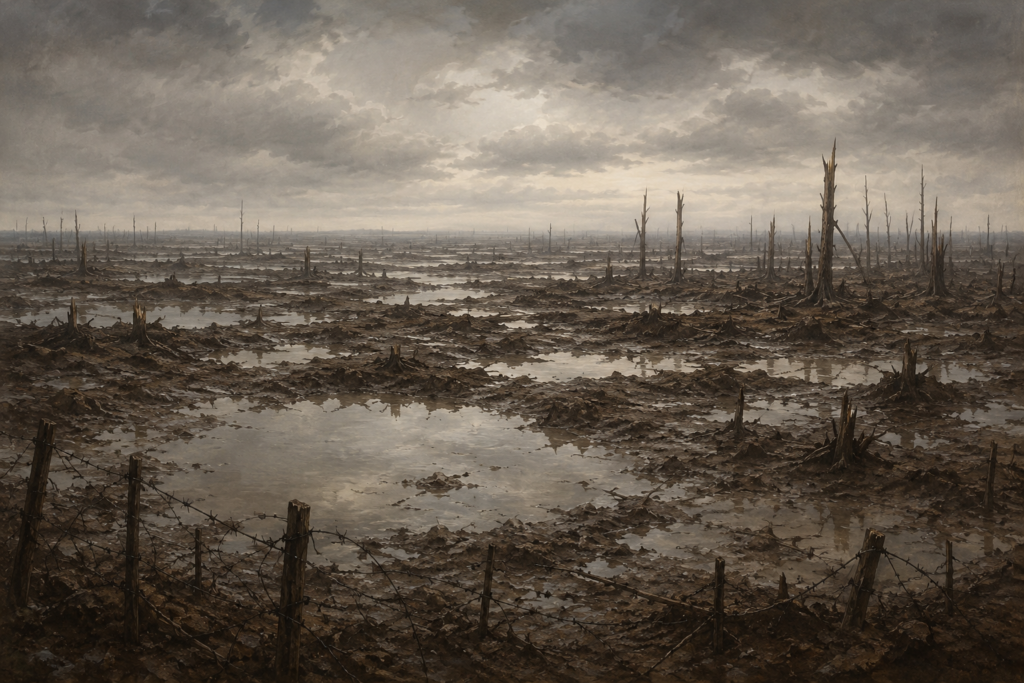
The battle opened on 31 July 1917 under Field Marshal Sir Douglas Haig, with the British, Canadian, Australian, New Zealand, and South African forces pushing north-east from the Ypres Salient toward the village of Passchendaele on the Passendale Ridge. The strategic aim was to break through to the Belgian coast and relieve pressure on a French army on the verge of mutiny. What followed was four months of grinding advance through waterlogged shell craters, collapsed trenches, and obliterated villages — in conditions so dreadful that men and horses drowned in the mud.
The village of Passchendaele was finally taken on 6 November 1917 by the Canadian Corps. The ridge that had cost so many lives was surrendered again within months during the German Spring Offensive of 1918, and retaken yet again before the Armistice. Virtually nothing of the original village survived the war.
Free Download
The WWI Battlefield Visitor Checklist
Everything to see, pack, and plan before you visit the Western Front — straight to your inbox.
No spam — just battlefield travel guides. Unsubscribe any time.
| “We were ordered to advance. The ground was a swamp. Men disappeared. Not wounded — gone. The mud took them.” — Sergeant Alfred West, 1st Lancashire Fusiliers, 1917 |
Getting to Passchendaele
By Air
The most convenient international airports are Brussels (BRU) and Lille-Lesquin (LIL). Both are approximately 90–100 minutes’ drive from Ypres, which makes them equally practical as arrival points. Calais and Dunkirk are also accessible by ferry from Dover if you prefer to bring your own car — and having your own vehicle makes visiting the scattered battlefield sites considerably easier.
By Train
Take the Eurostar from London St Pancras to Lille-Europe (approximately 1 hour 20 minutes), then a regional train to Kortrijk, followed by a local connection to Ieper (Ypres) station. The full journey from London to Ypres by rail takes around three to three and a half hours. From Ypres, Passchendaele is a 20-minute drive north-east — there is no direct public transport link, so a hire car, taxi, or guided tour is necessary for the sites themselves.
By Car from the UK
Cross-Channel via Eurotunnel (Folkestone to Calais) or ferry (Dover to Calais or Dunkirk), then drive south through France or Belgium. Ypres is signposted from the E40 motorway. Total drive time from the Channel Tunnel terminal is approximately 45 minutes. Driving your own car gives you the freedom to stop at roadside cemeteries and memorials that tour coaches cannot easily access — for battlefield travel, it is often the most rewarding approach.
What to See: The Key Sites
1. Tyne Cot Cemetery and Memorial
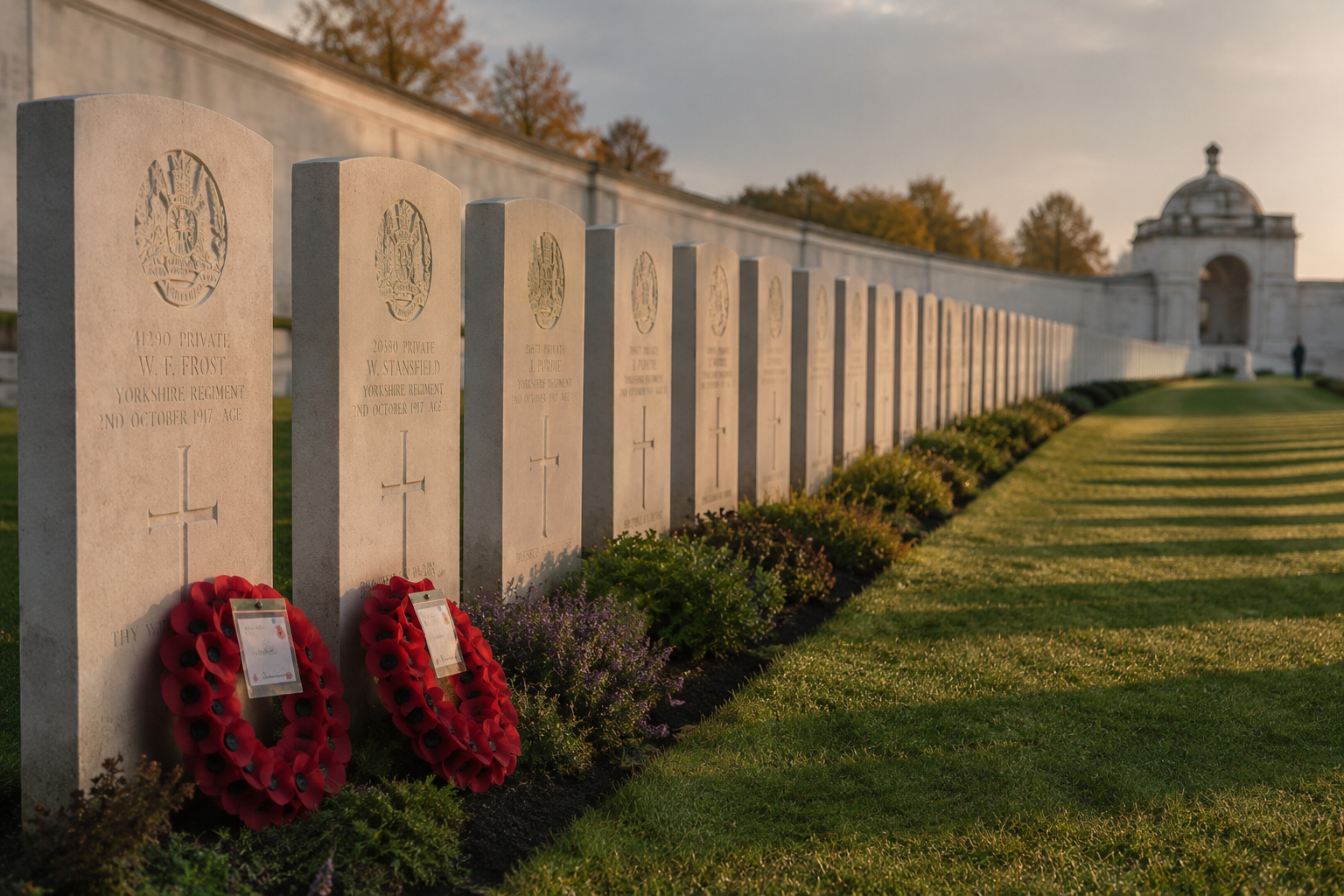
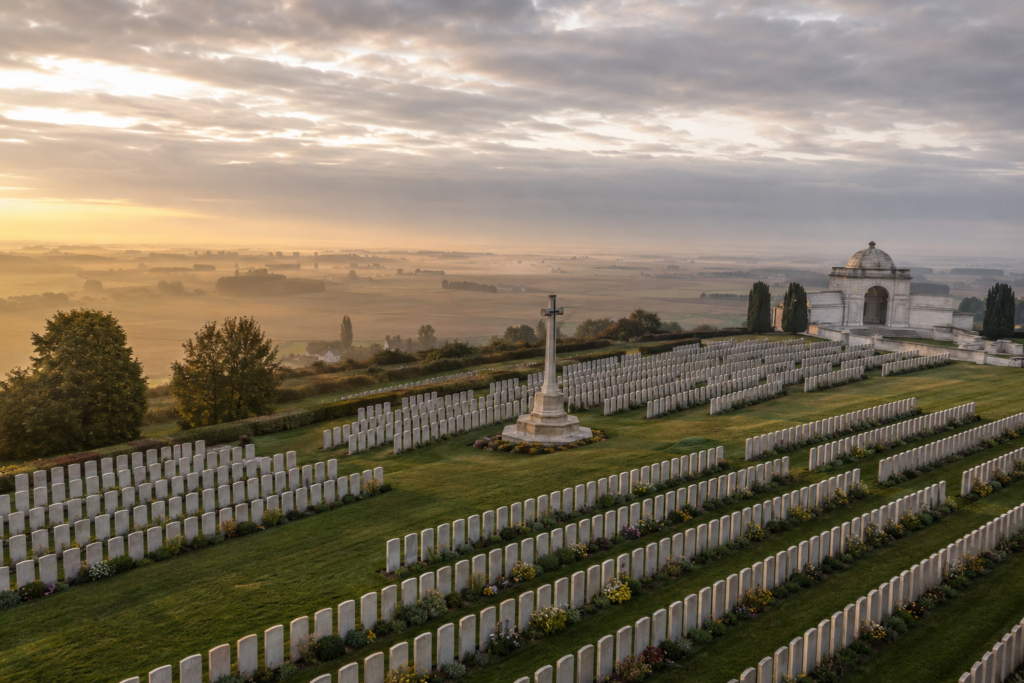
Tyne Cot is the largest Commonwealth war cemetery in the world, and standing among its 11,956 graves for the first time is an experience that resists description. The headstones stretch across a gentle slope, row after row, in the precise geometric order of the Commonwealth War Graves Commission. At the back wall, the Tyne Cot Memorial bears the names of nearly 35,000 soldiers who died in the Ypres Salient after 15 August 1917 and whose bodies were never recovered.

The name ‘Tyne Cot’ was given by Northumberland Fusiliers who thought the German blockhouses on the site resembled Tyneside cottages. King George V visited in 1922 and requested that the Cross of Sacrifice be built over one of those original blockhouses — the concrete pillbox is still visible beneath the cross today.
| Opening hours | Open daily, 24 hours (visitor centre: 10:00–18:00 Apr–Oct; 10:00–17:00 Nov–Mar) |
| Entry | Free |
| Address | Tyne Cotstraat 182, 8700 Passendale, Belgium |
| Allow | 1–2 hours minimum; 3 hours to read the memorial panels carefully |
2. Passchendaele New British Cemetery
Smaller and less visited than Tyne Cot, this cemetery sits on the ridge where the fighting reached its final stages in November 1917. It contains 2,101 Commonwealth burials, many of them Canadian soldiers who fell in the final push. The elevated position gives a sense of how the ridge dominated the surrounding landscape — and why both sides fought so desperately to hold it.
3. In Flanders Fields Museum, Ypres
While technically in Ypres rather than Passchendaele, the In Flanders Fields Museum in the Cloth Hall is the essential starting point for understanding the Ypres Salient — and therefore Passchendaele. The exhibition is exceptionally well designed, using personal testimonies, interactive displays, and original artefacts to bring the four years of fighting around Ypres to life. Visitors receive a personalised poppy bracelet linked to the story of an individual soldier, nurse, or civilian from the war.
| Opening hours | Tue–Sun 10:00–18:00 (last entry 17:00); closed Mon except public holidays |
| Entry | Adults €16 / Under 18s free |
| Address | Grote Markt 34, 8900 Ieper, Belgium |
| Website | inflandersfields.be |
4. Passchendaele Museum 1917
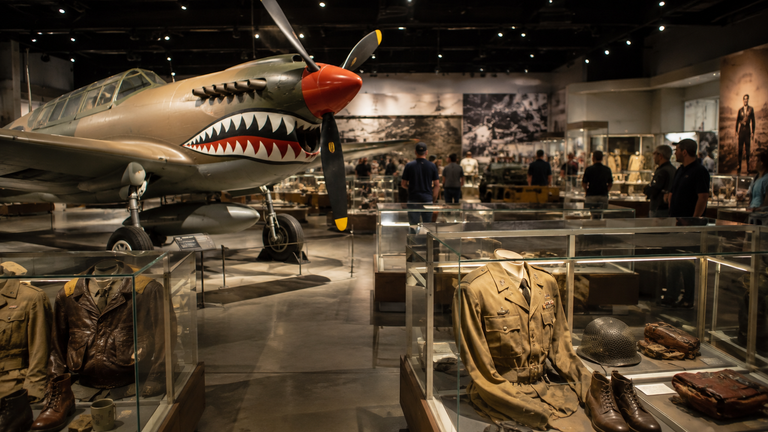
Opened in 2004, the Passchendaele Museum in the village itself is a more intimate counterpart to the In Flanders Fields Museum. It focuses specifically on the Third Battle of Ypres and gives considerable attention to the experiences of the civilian population — often overlooked in battlefield accounts focused solely on the military narrative. The museum includes a reconstructed dugout and trench section, and a significant collection of recovered artefacts.
| Opening hours | Daily 09:00–18:00 (Apr–Oct); Tue–Sun 09:00–17:00 (Nov–Mar) |
| Entry | Adults €8 / Children €4 |
| Address | Ieperstraat 5a, 8980 Zonnebeke, Belgium |
| Website | passchendaele.be |
5. Polygon Wood Cemetery and the Buttes New British Cemetery
Polygon Wood was captured by the Australian 5th Division on 26 September 1917 during the Battle of Polygon Wood — one of the most precisely planned of all the Passchendaele phase operations. The site contains a distinctive polygon-shaped stand of trees, the Buttes New British Cemetery, and the Polygon Wood Australian memorial. The cemetery contains 2,088 burials; the Memorial to the Missing bears 98 names.
Walking through the wood today, it is difficult to believe this was a completely shattered stump field in 1917. The regrowth of the forest in the decades since the war is itself a kind of memorial.
6. Zonnebeke Village and the Memorials Trail
The village of Zonnebeke, adjacent to Passchendaele, sits at the heart of the battlefield. A well-signposted memorials trail connects the key sites in the area on foot or by bike — an excellent option in summer. The trail takes approximately half a day by bicycle and passes Tyne Cot, Polygon Wood, and several smaller cemeteries and roadside memorials that rarely feature in guided tours but contain stories just as worthy of attention.
Visiting Respectfully
The battlefields around Passchendaele are active archaeological sites as well as places of remembrance. Each year, the Iron Harvest — the ploughing up of unexploded shells, grenades, and other munitions by Belgian farmers — recovers tens of thousands of items. If you see any metal objects in fields, do not touch them. Report them to local authorities.
| At the cemeteries, silence is appreciated. Photography is permitted but should be handled sensitively. Never walk on the graves, and be aware that these are not monuments — they are the resting places of individuals, most of whom died before the age of 30. The Commonwealth War Graves Commission cares for each headstone individually; the name on each one belongs to a real person with a family history that can often be researched online. |
Where to Stay
In Ypres (Ieper)
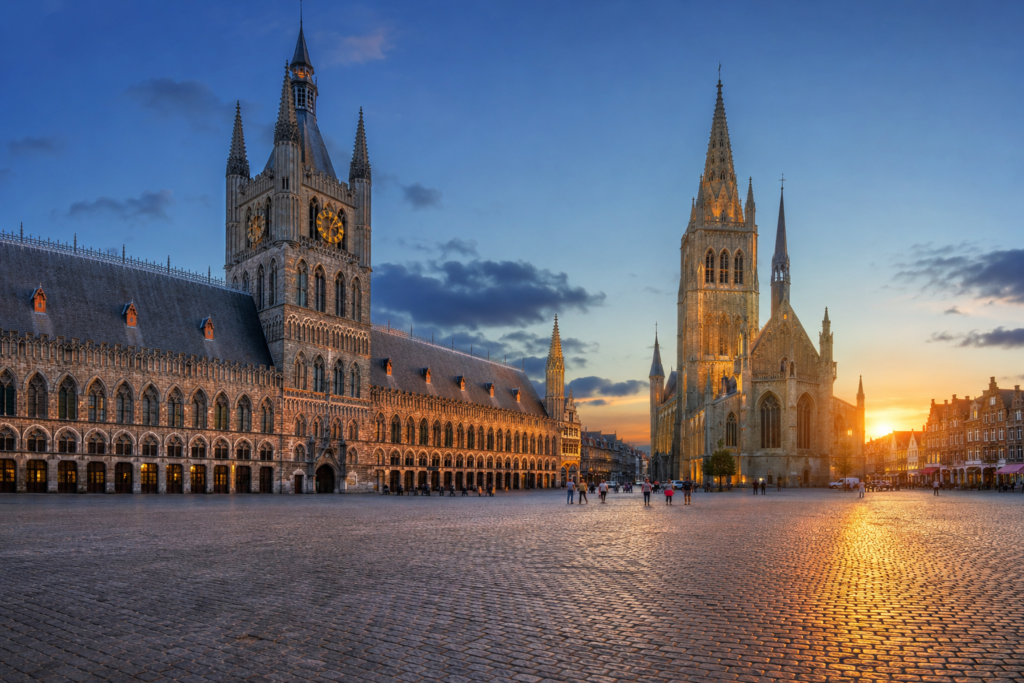
Ypres is the natural base for visiting Passchendaele and the wider Western Front. The town was almost entirely destroyed during the war and rebuilt in the 1920s as a near-identical replica of its medieval self — the result is a slightly uncanny but genuinely beautiful town centre, dominated by the Cloth Hall and St Martin’s Cathedral. There is a good range of accommodation from budget to boutique.
Regina Hotel (Grote Markt 45) — A traditional three-star hotel directly on the main square, within walking distance of the Cloth Hall and Menin Gate. Well regarded by battlefield visitors.
Ariane Hotel — One of the best mid-range options in Ypres, with comfortable rooms and helpful staff who are accustomed to battlefield travellers and can recommend routes and sites.
B&Bs and guesthouses — Several good independent guesthouses operate in and around Ypres; many are run by owners with deep knowledge of the local history and are excellent sources of local insight.
Closer to Passchendaele: Zonnebeke and the Rural Salient
For visitors who want to wake up within the battlefield itself rather than in the town, there are a number of excellent rural guesthouses and farm stays in the Zonnebeke and Passendale area. Staying in the Salient rather than in Ypres gives a very different quality of experience — especially in the early mornings, when the fields are quiet and the landscape has a stillness that is hard to find later in the day when tourist coaches arrive.
Check Booking.com and local Belgian tourism listings (visitvlaanderen.be) for current availability of rural accommodation in the Zonnebeke commune.
Self-Catering and Gîtes
For groups, families, or visitors spending several nights, self-catering properties are available in the rural villages surrounding Ypres. Many Belgian farmhouses in the area have been converted into holiday lets. This is often the best option for those using a car to explore multiple sites over several days.
Guided Tours vs Self-Guided
Guided Battlefield Tours
For a first visit, a guided tour is strongly recommended. The landscape gives few visual clues to what happened here without context, and a good battlefield guide transforms the experience entirely. The best guides work from primary sources — diaries, letters, unit histories — and can bring specific individuals’ stories to the exact ground where they fought and died.
Several reputable operators run day trips and multi-day tours from the UK:
- Leger Holidays — a leading UK specialist in WWI and WWII battlefield tours with experienced guides
- Anglia Tours — smaller group sizes, often with author or historian-led programmes
- Battlefields of Europe — specialist tours with academic historian commentary
- GetYourGuide and Viator — both offer day trips from Ypres, useful for independent travellers already in the area
Self-Guided Itinerary
If you prefer to go independently, a logical self-guided day route from Ypres to Passchendaele and back covers the key sites in a full day:
| 09:00 | In Flanders Fields Museum, Ypres (allow 2 hours) |
| 11:15 | Drive to Tyne Cot Cemetery (20 mins). Allow 1.5–2 hours. |
| 13:30 | Lunch in Zonnebeke village |
| 14:15 | Passchendaele Museum 1917 (allow 1.5 hours) |
| 15:45 | Polygon Wood Cemetery and the Buttes |
| 17:00 | Drive the memorials trail route or return to Ypres |
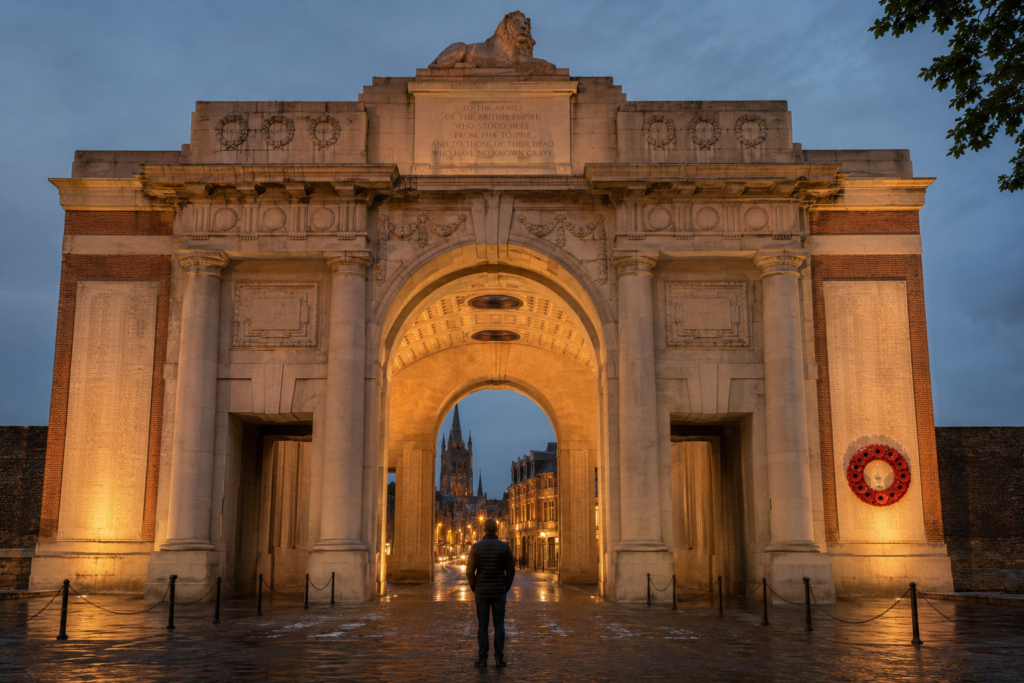
| 20:30 | Menin Gate Last Post Ceremony (every evening at 20:00 — do not miss this) |
Practical Information
Best Time to Visit
The Ypres Salient can be visited year-round, but April to October offers the most comfortable conditions. July and August are peak season with the highest visitor numbers — if you prefer a more meditative experience, late September and October are outstanding: the light is low and golden, the crowds have thinned, and the remembrance season (culminating in Remembrance Sunday in November) lends the visit additional weight.
Remembrance Sunday (the second Sunday of November) sees major ceremonies at Tyne Cot and the Menin Gate — if you are able to attend, it is a profound experience. Book accommodation very early as it fills months in advance.
Getting Around
A hire car is the most flexible option for visiting the scattered battlefield sites. Many sites are accessible by bicycle — the Salient cycle routes are well maintained and clearly signed. Guided tours typically include transport from Ypres or from the UK.
What to Bring
- Sturdy waterproof footwear — fields and cemeteries can be wet even in summer
- Warm layers — the Belgian Flanders climate is changeable
- A good guidebook (see recommendations below)
- A notebook — many visitors find they want to record what they see and feel
- Binoculars for surveying wider landscape from ridge positions
Recommended Reading
Lyn Macdonald’s They Called It Passchendaele remains the definitive popular history of the battle, assembled from hundreds of veterans’ testimonies. Alistair Horne’s The Price of Glory covers Verdun and is useful context for understanding the broader 1917 Allied strategic situation. Leon Wolff’s In Flanders Fields offers a more critical perspective on the campaign’s leadership. All are available from good booksellers and via Amazon.
Is Passchendaele Worth Visiting?
The question almost answers itself once you are standing at Tyne Cot, looking out over nearly 12,000 headstones toward the ridge that cost so much to reach. But for those still deciding whether this is the right destination for them, the honest answer is: yes, always — but come prepared.
This is not a conventional tourist experience. There are no theme parks, no gift shops of the kind that trivialise these places, no easy emotional distance from what happened here. The experience asks something of the visitor: attention, patience, and a willingness to sit with the weight of what the landscape carries.
What it gives back is a connection to the past that very few heritage destinations can match. The men buried at Tyne Cot, the names on the memorial wall, the craters still visible in farmers’ fields — these are not the distant traces of ancient history. They are the record of something that happened within living memory of people still alive today, to young men from villages and cities across Britain, Canada, Australia, New Zealand, and South Africa.
| Passchendaele is not a comfortable place to visit. It is not meant to be. But it may be one of the most important journeys you ever make. |