WWl Cemeteries and Memorials: A Guide to CWGC Sites in Belgium and France
More than 900,000 Commonwealth casualties are commemorated across nearly 3,000 cemeteries and memorials in Belgium and France. This guide covers the most significant CWGC sites, how to find them, and how to visit them with the respect they deserve.
What Is the Commonwealth War Graves Commission?
The Commonwealth War Graves Commission (CWGC) was established in 1917 — while the war was still being fought — to ensure that every Commonwealth serviceman and woman who died would be commemorated individually, regardless of rank. The principle was radical for its time: no separate plots for officers and enlisted men, no repatriation of bodies, no variation in headstone size based on wealth or status.

Today, the CWGC maintains 1.7 million graves across 23,000 locations in more than 150 countries. The largest concentration of its work — and the most visited — is in Belgium and northern France, where the Western Front stretched for four years.
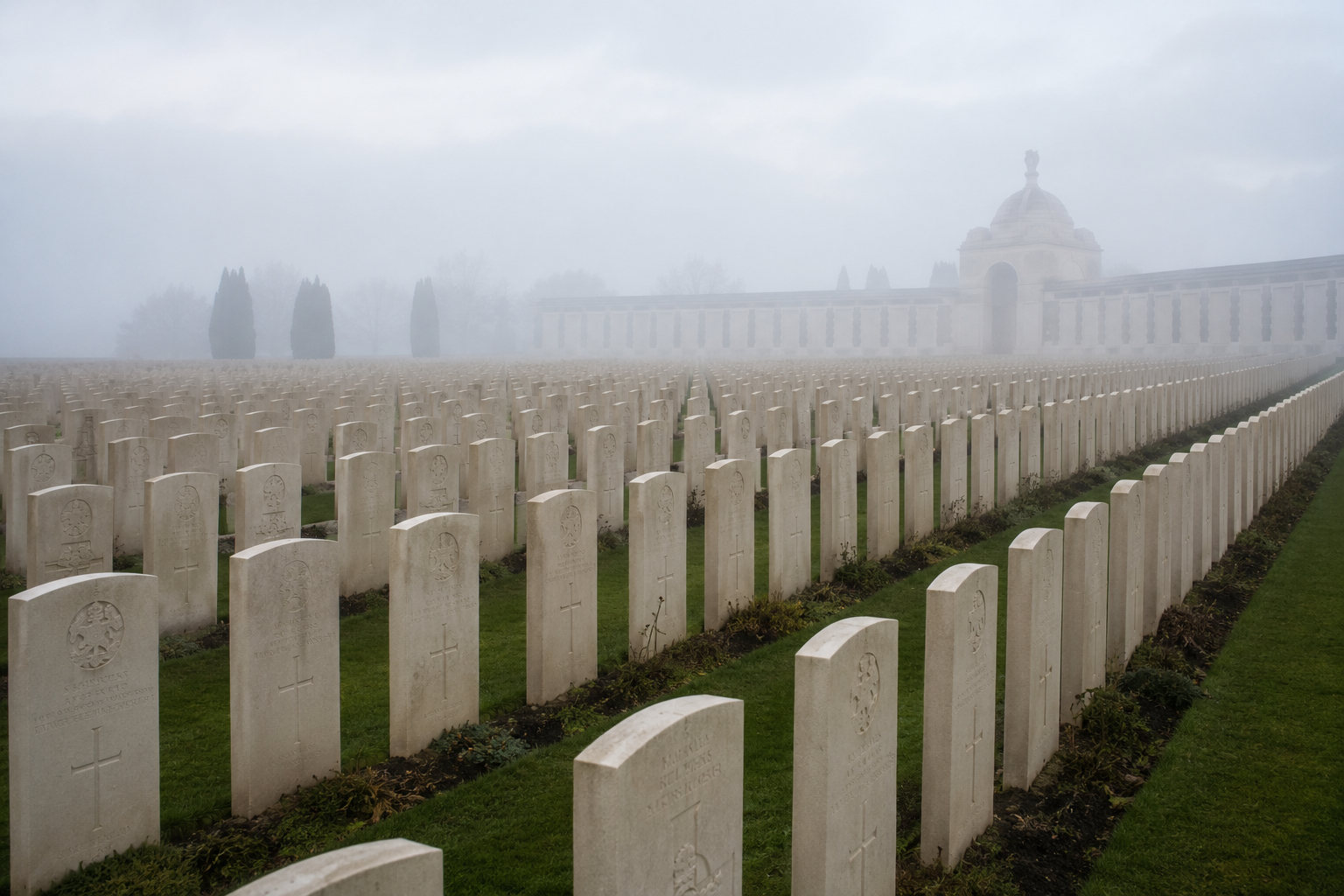
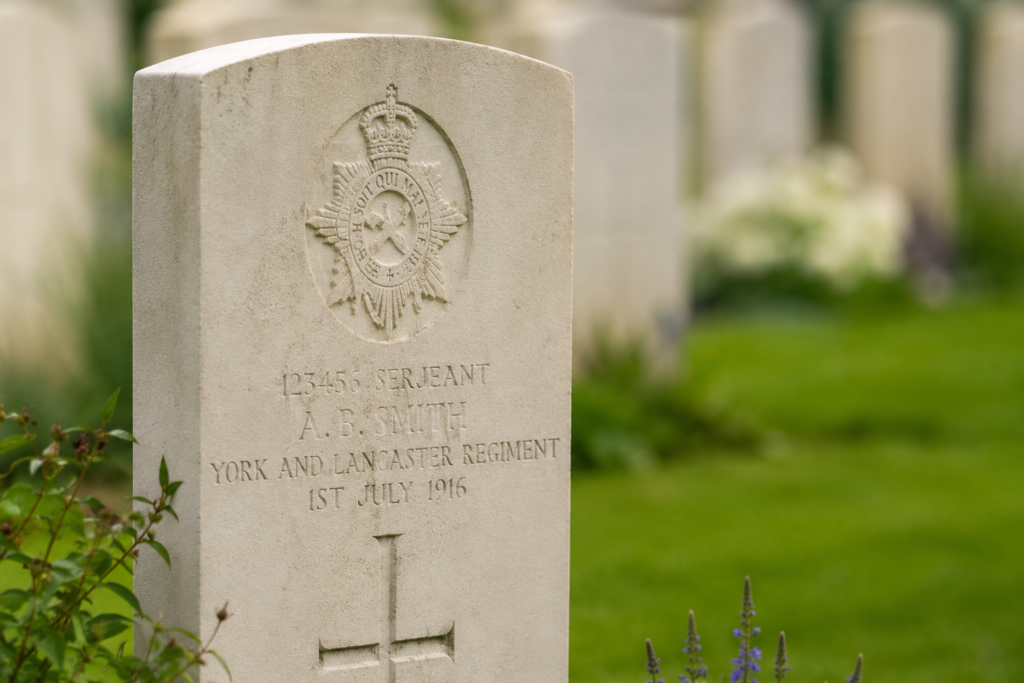
The standard CWGC headstone is a white Portland stone tablet, 76cm tall and 38cm wide, bearing the serviceman’s name, rank, regiment, age, date of death, and a personal inscription chosen by the next of kin. Walking the rows of them, uniform and immaculate in their thousands, remains one of the most powerful experiences in all of European travel.
Free Download
The WWI Battlefield Visitor Checklist
Everything to see, pack, and plan before you visit the Western Front — straight to your inbox.
No spam — just battlefield travel guides. Unsubscribe any time.
How the CWGC Website Can Help You Plan Your Visit
Before you travel, the CWGC’s online Debt of Honour Register is one of the most useful tools available to any battlefield visitor. You can search by name, regiment, nationality, and location to find exactly where a specific soldier is commemorated — whether buried in a named grave or listed on one of the great memorials to the missing.
The register tells you:
- The name and location of the cemetery or memorial
- GPS coordinates and a map link
- The individual’s rank, regiment, date of death, and age
- Any personal inscription on the headstone
- A photograph of the headstone, where available
If you are visiting to find a specific ancestor or regimental comrade, search the register first, print the map reference, and bring it with you. Cemetery registers — physical books listing every name — are also kept in green bronze boxes at the entrance to every CWGC cemetery.
Key CWGC Sites in Belgium (Flanders)
The Ypres Salient — the bulge in Allied lines around the town of Ieper (Ypres) — saw some of the war’s most sustained and costly fighting. The concentration of CWGC cemeteries and memorials within a 30-kilometre radius of the town is unmatched anywhere in the world.
Tyne Cot Cemetery and Memorial to the Missing
Tyne Cot is the largest Commonwealth war cemetery in the world. It contains 11,956 graves — the majority of them unidentified — and the Memorial to the Missing at the rear wall bears a further 34,888 names of men who have no known grave, lost in the battles of Passchendaele and the wider Ypres Salient from August 1917 onwards.
The name ‘Tyne Cot’ is believed to derive from Northumberland Fusiliers who thought the German pillboxes on the site resembled Tyneside cottages. Several of those pillboxes still stand within the cemetery — one serves as the base for the Cross of Sacrifice at the centre of the site.
Practical details:
- Location: Passendale, approximately 9km northeast of Ieper
- Open: Daily, all year, dawn to dusk. Free admission.
- Visitor centre on site with exhibitions, research facilities, and a café
- Allow at least 90 minutes — the cemetery is larger than it first appears
- Parking available on site. Accessible for wheelchair users on the main paths
Essex Farm Cemetery
Essex Farm is modest in size — around 1,200 graves — but carries enormous symbolic weight. This is the site where Canadian surgeon Lieutenant Colonel John McCrae wrote ‘In Flanders Fields’ in May 1915, looking out over the freshly dug graves of his fellow soldiers. A small memorial marks the spot, and the dressing station bunkers where McCrae worked are still visible.
Look out for the grave of Valentine Joe Strudwick, one of the youngest soldiers to die in the war, killed at the age of 15 — a sobering reminder of the age at which many boys enlisted.
Practical details:
- Location: Just north of Ieper on the N369, along the bank of the Yser Canal
- Open: Daily, all year. Free admission.
- Small car park at the roadside. Accessible paths throughout.
- Easily combined with a visit to Ieper town centre and the In Flanders Fields Museum
Langemark German War Cemetery
Not a CWGC site — but worth including here because visiting it alongside the Commonwealth cemeteries fundamentally changes how you understand the Salient. Langemark is the principal German war cemetery in Belgium, and it couldn’t be more different in atmosphere from Tyne Cot. Where the CWGC sites are airy and white, Langemark is dark and dense: black basalt crosses, mature oak trees casting deep shade, and mass graves holding the remains of 24,917 German soldiers in a relatively small space.
The contrast between the two countries’ approaches to commemoration is a history lesson in itself. Many visitors find Langemark the more affecting of the two, precisely because of its sombre compression.
The Menin Gate Memorial to the Missing, Ieper
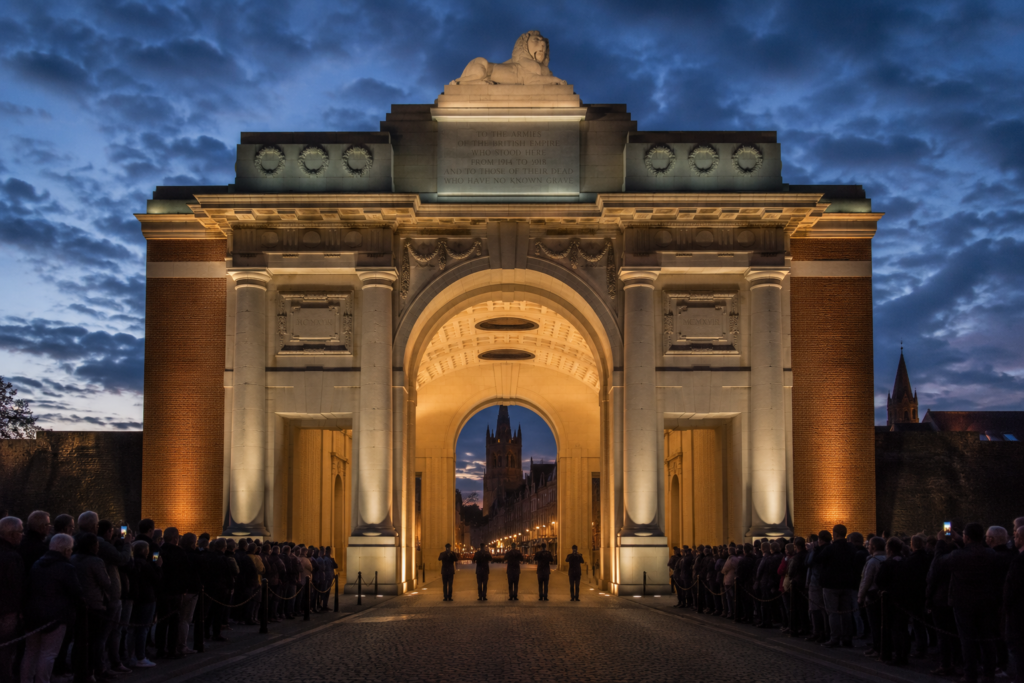
Strictly speaking the Menin Gate is a memorial rather than a cemetery, but it is the emotional heart of any visit to the Ypres Salient. The vast stone arch bears 54,896 names — soldiers of the British and Commonwealth forces who died in the Salient before August 1917 and have no known grave. Panels are organised by nationality and regiment, with British, Australian, Canadian, South African, and Indian units all represented.
Every evening at 8pm, the Last Post ceremony has been held here since 1928 — interrupted only during the German occupation of the Second World War. It takes perhaps ten minutes: local buglers from the Last Post Association sound the Last Post, there is a silence, and wreaths are laid. It is entirely free to attend and requires no booking.
Practical details:
- Location: The Menin Gate stands at the eastern edge of Ieper town centre on the Meensestraat
- Last Post ceremony: Every evening at 8pm, year-round. Free, no booking required.
- Arrive 20–30 minutes early on summer evenings and around Remembrance season (late October/November) — crowds can be large
- The gate is accessible 24 hours; the surrounding names can be searched and located via the CWGC website in advance
Key CWGC Sites in France
The Somme and the Arras sectors in northern France hold the largest concentration of CWGC sites outside Belgium. The battles of the Somme (1916) and Arras (1917) produced casualty lists that still stagger the imagination; the landscape today is quietly agricultural, but the cemeteries appear every few kilometres along the back roads.
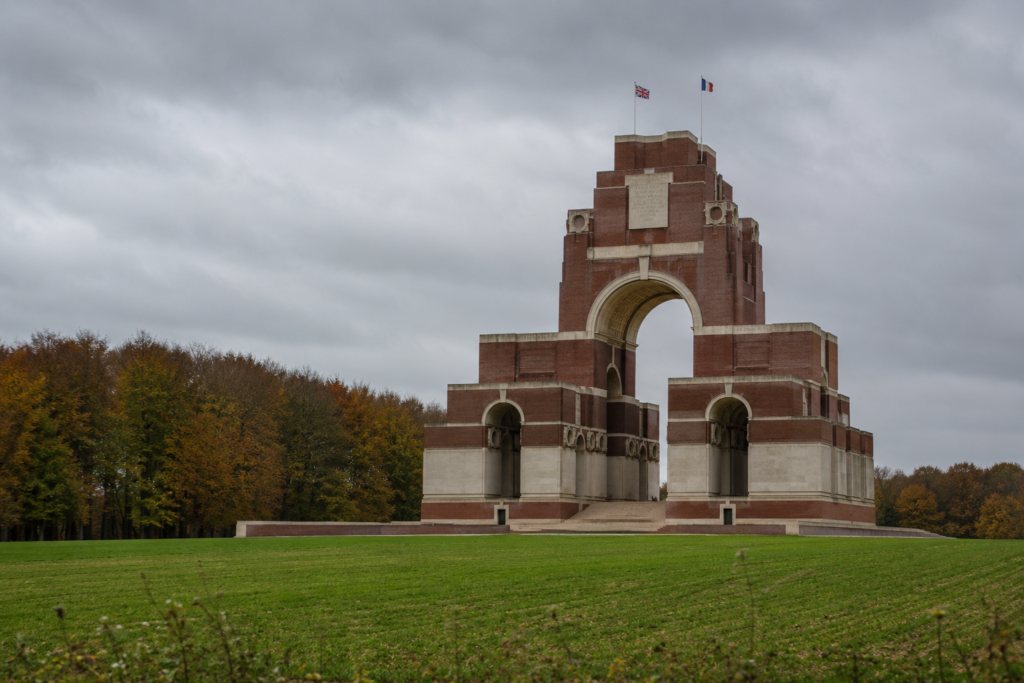
Thiepval Memorial to the Missing of the Somme
Thiepval is the largest British memorial in the world and the defining structure of the Somme battlefield. Designed by Edwin Lutyens and unveiled in 1932, the brick arch rises 45 metres above the Somme ridge and is visible for miles across the valley. Its sixteen piers bear 72,195 names — British and South African soldiers who died on the Somme between 1915 and 1918 with no known grave.
A small Anglo-French cemetery stands beneath the arch, symbolically containing both British and French graves — the Somme was a joint Allied offensive. The visitor centre beside the memorial is excellent, with detailed maps of the 1916 battles and personal stories of the men commemorated.
Practical details:
- Location: Near the village of Thiepval, approximately 8km northeast of Albert, Somme
- Visitor centre open: Daily. Closed mid-December to mid-January. Free admission.
- The memorial itself is open all year, dawn to dusk
- Allow at least 2 hours including the visitor centre
- Ample parking on site
Lochnagar Crater and Ovillers Military Cemetery
At 7.28am on 1 July 1916 — two minutes before zero hour on the first day of the Battle of the Somme — British tunnellers detonated a mine beneath the German lines near La Boisselle. The resulting crater is 91 metres across and 21 metres deep. Standing at its rim, it is still difficult to process the violence it represents. The crater is privately owned and maintained as a memorial; entry is free.
A few hundred metres away, Ovillers Military Cemetery contains 3,440 graves — more than half unidentified — from the fighting around La Boisselle and Ovillers in the summer of 1916. It is one of the most intimate of the Somme cemeteries, tucked into a slight valley in a way that makes the scale of the losses feel very close.
Vimy Ridge Canadian National Memorial
Vimy Ridge has an almost sacred significance for Canadians: the April 1917 assault on the ridge was the first time all four divisions of the Canadian Corps fought together, and their success in taking ground that had repelled French forces for two years became foundational to Canadian national identity. The memorial — two soaring white limestone pylons on the highest point of the ridge — is one of the most beautiful and melancholy structures on the Western Front.
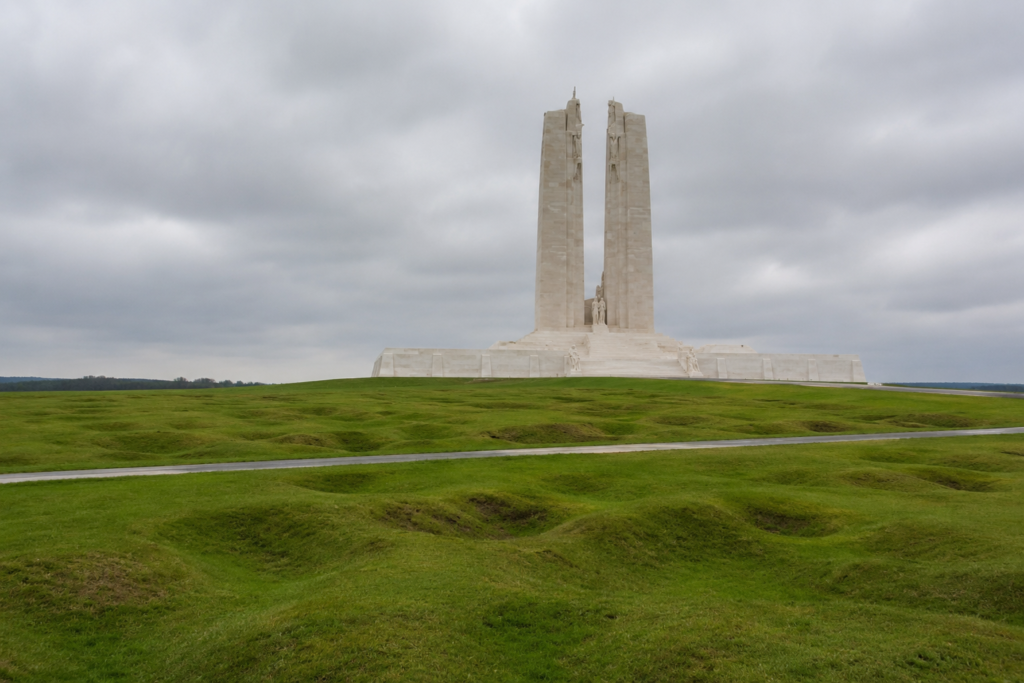
The preserved Canadian tunnel system beneath the ridge can be visited on a free guided tour run by young Canadian volunteers — one of the most memorable experiences the Western Front has to offer. The trench system in the park has been preserved and partially reconstructed, and the shell-pocked landscape around the memorial has been left as it was, still too disturbed by unexploded ordnance to be cultivated.
Practical details:
- Location: 10km north of Arras, just off the A26 autoroute
- Memorial and grounds: Open daily, all year. Free admission.
- Tunnel tours: Run by Parks Canada volunteers, typically April to November. Free. Check Parks Canada website for current hours.
- Allow 2–3 hours minimum
- Large car park on site; café and visitor facilities available in season
Notre-Dame-de-Lorette and the Ring of Memory
The Nécropole Nationale de Notre-Dame-de-Lorette is the largest French military cemetery in the world, holding the remains of more than 40,000 French soldiers on a ridge above the Artois plain. The site also includes a basilica and an ossuary. The scale of it — and the relative rarity of its inclusion on British battlefield itineraries — gives it a quieter, more contemplative atmosphere than the most-visited CWGC sites.
Adjacent to the cemetery, the Ring of Memory (L’Anneau de la Mémoire) is a striking elliptical structure opened in 2014 to mark the centenary of the war’s outbreak. It bears 579,606 names — every soldier of every nationality killed on the Northern Front between 1914 and 1918, arranged alphabetically without distinction of nationality. French, German, British, Australian, Algerian, and Moroccan soldiers appear side by side. It is a quietly radical act of commemoration.
Visiting CWGC Cemeteries: Practical Etiquette
CWGC cemeteries are simultaneously working cemeteries and places of great emotional significance for descendants and veterans’ organisations. A few guidelines will help ensure your visit is respectful:
- Keep voices low, particularly in smaller cemeteries. The sites attract people who have come to find the graves of relatives.
- Photography is welcome, but consider the presence of other visitors before taking wide-angle shots that include them.
- Children are welcome and battlefield visits can be profoundly educational — but do prepare them for what they will see. The sheer number of graves can be distressing without context.
- Do not climb on headstones, walls, or memorial structures. The Portland stone headstones are fragile and irreplaceable.
- Picnicking inside cemeteries is discouraged, though eating and drinking in the car park is fine.
- If you find a headstone that has fallen or appears damaged, report it to the CWGC via their website rather than attempting to move or repair it yourself.
- The gardens are immaculately maintained by CWGC gardeners — please do not pick flowers. The seasonal planting is a deliberate horticultural programme.
Planning Your Visit
When to Go
The most atmospheric time to visit is early morning or late afternoon — the low light on the white headstones is extraordinary, and you will often have smaller cemeteries to yourself. Summer (June–August) brings the most visitors, particularly around the D-Day and Somme anniversaries. Remembrance season (late October through November 11) is when the sites are most emotionally charged — the Last Post ceremony at the Menin Gate in particular draws very large crowds on November 11.
April and May offer excellent weather, lighter crowds, and the added poignancy of the battlefield landscape in spring — poppies begin to appear in the fields around the Somme from late April onwards.
Getting There
Ypres (Ieper) is approximately 2.5 hours by car from Calais via the A25 and E403, making it easily reachable in a day from the UK via Eurotunnel or P&O Ferries. Albert (the gateway town for the Somme) is around 2 hours from Calais.
Public transport to the smaller cemeteries is limited. Guided tours — either day trips from London or multi-day tours based in Ypres or Arras — offer the most practical way to cover the key sites without a car. Self-driving is ideal for those who want to stop at smaller, less-visited cemeteries on back roads.
Where to Stay
Ieper (Ypres) is the natural base for Belgian battlefield visits — the town centre has been beautifully restored and has good hotels, restaurants, and the outstanding In Flanders Fields Museum. For the Somme, Albert is the traditional base, though Arras (larger, more facilities) works equally well for the northern Somme sites and Vimy Ridge. Amiens makes a good base for those also visiting the southern Somme.
A Final Note
There is a particular quality to time spent in CWGC cemeteries that is hard to articulate to someone who hasn’t experienced it. They are not grim or oppressive — the CWGC deliberately designed them as gardens, and the effect is one of extraordinary, cared-for peace. What strikes most visitors is the individuality: every name, every date, every regimental badge is different, and the cumulative weight of individual stories is more affecting than any single fact about the scale of the losses.
Take your time. Read the names. Look at the ages. Find the regiments. The CWGC’s work is not just about the past — it is an ongoing act of remembrance, maintained every day by gardeners who treat this as more than a job. That intention is visible in every well-clipped hedge and freshly planted rosebush.
They were here. The least we can do is come and see.