How to Plan an Independent Western Front Road Trip
| WHY THIS TRIP MATTERS The Western Front stretches over 700 kilometres from the Belgian coast to the Swiss border. Along it lie the most visited, most moving, and most historically significant battlefield sites in the world. This guide tells you everything you need to plan and drive it yourself — at your own pace, on your own terms. |
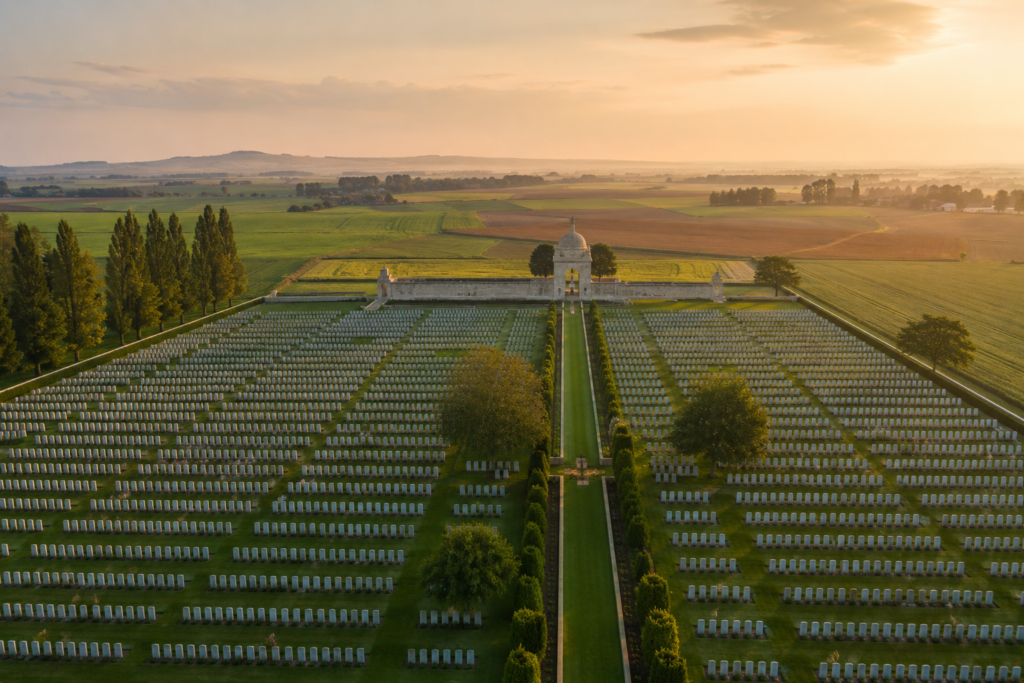
There is something profoundly different about arriving under your own power at the Menin Gate at dusk, or pulling off a country road in the Somme valley to find yourself alone at a Commonwealth War Graves Commission cemetery, rows of white headstones stretching away in perfect silence. Guided tours are excellent. But an independent Western Front road trip gives you something guided tours cannot: time.
Time to sit. Time to read a headstone and wonder. Time to take the side road nobody else is taking, to find the crater that isn’t on any itinerary, to stay long enough in one place that the weight of it settles properly.
This guide is for independent travellers who want to drive the Western Front — or a meaningful section of it — without handing control to anyone else. It covers the route, the essential sites, where to base yourself, what to read before you go, and how to plan a trip that is logistically straightforward and emotionally profound.
Understanding the Western Front: The Basics
Before you plan the route, it helps to understand what the Western Front actually was. From late 1914 to November 1918, the opposing armies of the First World War faced each other across a line of trenches that ran from the North Sea coast of Belgium, through northern France, and down to the Swiss border — a total distance of roughly 700 kilometres.
Free Download
The WWI Battlefield Visitor Checklist
Everything to see, pack, and plan before you visit the Western Front — straight to your inbox.
No spam — just battlefield travel guides. Unsubscribe any time.
This guide focuses on the northern section of the Front, from Ypres (now Ieper) in Belgium down through the Somme and Artois regions of northern France to Verdun. This stretch contains the highest concentration of significant sites and is the most accessible from the UK.
| TRAVELLER’S NOTEThe Western Front is not a single attraction — it is a landscape. The cemeteries, memorials, museums, and preserved trenches are scattered across farmland, towns, and villages. A road trip is by far the best way to experience it properly. Public transport links between sites are extremely limited. |
How Long Do You Need?
The honest answer is: longer than you think. The single most common regret among Western Front visitors is not having allowed enough time. Here are three realistic trip lengths and what they allow you to cover:
| 3–4 days | A focused trip covering either the Ypres Salient (Belgium) or the Somme (France) in depth. Right for first-timers who want to do one area properly rather than rush through both. |
| 5–7 days | The most popular length. Covers Ypres and the Somme comfortably, with time for Arras and Vimy Ridge. Allows for slower travel and meaningful time at each site. |
| 10–14 days | The full northern Front experience — from Ypres to Verdun, with time for Arras, the Somme, and the Chemin des Dames. For serious history travellers or those tracing family history. |
Getting There: Crossing from the UK
The Western Front is exceptionally accessible from the UK. Most travellers drive to the sites, which gives you the flexibility the trip demands.
Via Eurotunnel (Recommended)
The fastest and most convenient crossing for most UK drivers. Folkestone to Calais in 35 minutes, with trains running around the clock. From Calais, Ypres is approximately 75 kilometres — under an hour.
Via Ferry: Dover to Calais
DFDS and P&O operate regular crossings; the journey takes around 90 minutes. A good option if you prefer the ferry experience or are booking late. From the Calais ferry terminal, the drive times are the same as from the Eurotunnel terminal.
Via Ferry: Hull to Zeebrugge or Rotterdam
P&O Ferries operates overnight crossings from Hull to Rotterdam and Zeebrugge. An excellent option for travellers from northern England or Scotland — you arrive rested and close to the Belgian battlefields. From Zeebrugge, Ypres is approximately 60 kilometres.
| DRIVING IN BELGIUM & FRANCE You will need your UK driving licence, vehicle registration document, and proof of insurance. A GB sticker or GB number plate is required in France. Both countries drive on the right. Speed limits: Belgium — 120 km/h motorway, 70 km/h outside built-up areas, 50 km/h in towns; France — 130 km/h motorway (110 in rain), 80 km/h on single carriageways, 50 km/h in towns. Breathalysers are no longer mandatory to carry in France, but speed camera detectors are illegal in both countries. |
The Route: A 7-Day Western Front Itinerary
The following itinerary is structured for a 7-day trip from the UK, covering the most significant sites between Ypres and the Somme. It can be extended to 10–14 days by adding Arras, Vimy Ridge, and Verdun, or compressed to 4–5 days by choosing one region.
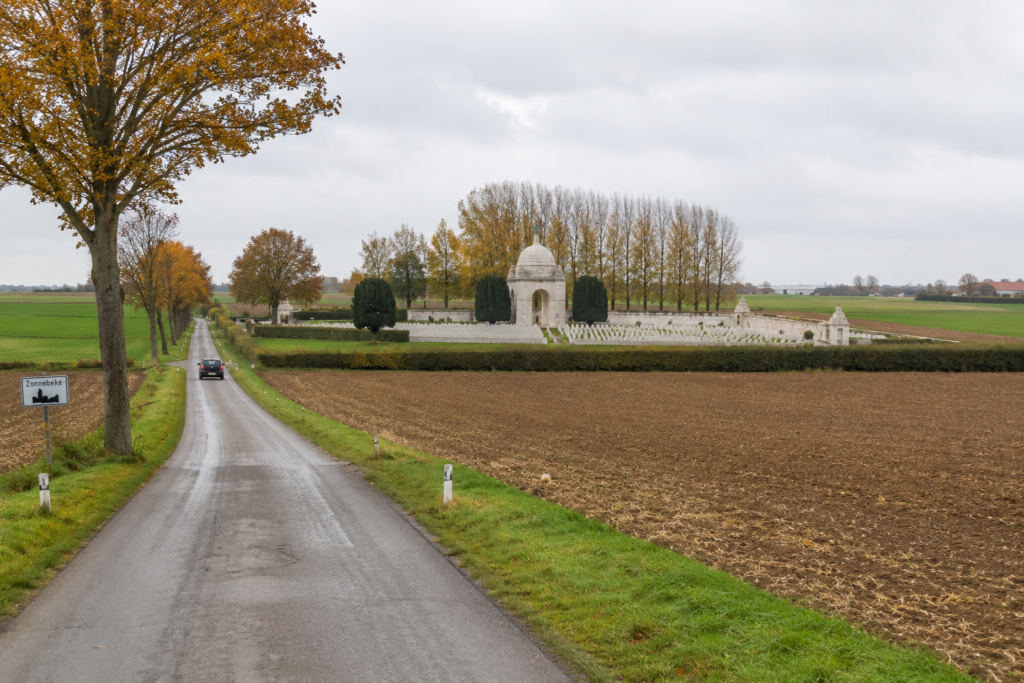
Day 1: Arrive in Ypres (Ieper)
Cross early via Eurotunnel or the overnight ferry and drive directly to Ypres. Check in to your accommodation, then spend the afternoon exploring the town at your own pace. Ypres was completely destroyed in the war and rebuilt identically afterwards — the Cloth Hall and St Martin’s Cathedral are remarkable pieces of historical reconstruction.
In the evening, attend the Last Post Ceremony at the Menin Gate. Held every single night at 8pm since 1928 (interrupted only during the Second World War occupation), it is one of the most moving rituals in Europe. Arrive by 7:45pm to get a position on the road.
- Accommodation base: Ypres town centre — numerous hotels and B&Bs within walking distance of the Menin Gate
- Evening: Last Post Ceremony at the Menin Gate (free, no booking required)
Day 2: The Ypres Salient
Spend the day exploring the Salient — the bulge in the Allied lines around Ypres where some of the war’s most intense fighting took place. Start at In Flanders Fields Museum in the Cloth Hall for essential historical context before visiting the sites.
- In Flanders Fields Museum — the best WWI museum in Belgium; allow 2–3 hours
- Tyne Cot Cemetery — the largest Commonwealth war cemetery in the world; nearly 12,000 graves
- Polygon Wood Cemetery and the Buttes New British Cemetery — among the most atmospheric sites in the Salient
- Passchendaele Memorial Museum at Zonnebeke — outstanding reconstruction of underground dugouts
Day 3: The Ypres Salient — Southern Sector
The southern part of the Salient contains some of the most significant preserved battlefield landscape in the world. Hill 60, the Caterpillar crater, and the preserved tunnels at Bayernwald give a visceral sense of the underground war.
- Hill 60 — a spoil heap from a local railway cutting, fought over repeatedly throughout the war; heavily mined
- The Caterpillar — a large preserved crater near Hill 60
- Ploegsteert Wood (‘Plugstreet’) — where Churchill served; quieter and less visited than the Salient proper
- Bayernwald — German trench system, one of the best-preserved on the Western Front
Day 4: Drive South — Arras and Vimy Ridge
Leave Ypres after breakfast and drive south into France. Arras (approximately 80km from Ypres) was a major Allied base throughout the war and contains one of the Western Front’s most extraordinary features: the Boves — a network of underground tunnels beneath the city used to shelter troops.
- Wellington Quarry (Carriere Wellington), Arras — underground tunnels tour, essential visit; book in advance
- Vimy Ridge Memorial — Canadian National Memorial on the ridge captured by the Canadian Corps in April 1917; stunning park and preserved trenches
- Neuville-Saint-Vaast German Cemetery — one of the largest German war cemeteries in France; stark and sombre by contrast with the Commonwealth cemeteries
Overnight in Arras — a handsome French city with good accommodation and restaurants around the grand central squares.
Day 5: The Somme — Northern Sector
Drive from Arras into the Somme valley. The Battle of the Somme began on 1 July 1916 — still the bloodiest single day in British military history — and continued for four and a half months. The landscape here is quieter and more rural than the Ypres Salient, which makes the scale of the cemeteries more striking.

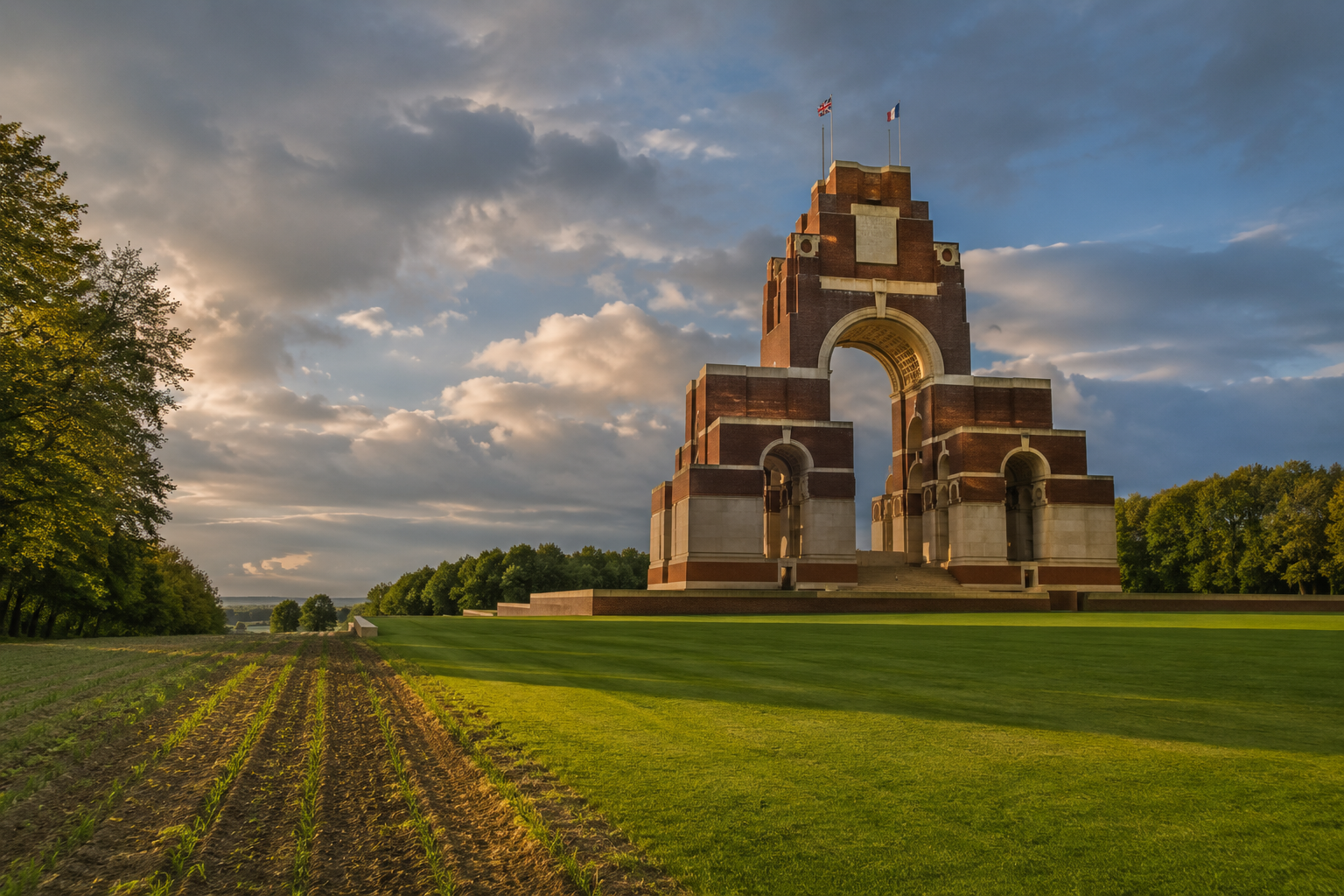
- Thiepval Memorial to the Missing of the Somme — the largest British memorial in the world, listing 72,000 names with no known grave
- Ulster Tower — memorial to the 36th (Ulster) Division; book guided tours in advance
- Beaumont-Hamel — preserved Newfoundland Memorial Park with original trench system and shell craters intact; one of the most powerful sites on the entire Front
- Serre Road cemeteries — a series of Commonwealth cemeteries along a quiet farm track, each with a different character
Overnight in Albert — the main town of the Somme battlefield area, with the Musee Somme 1916 worth an evening visit.
Day 6: The Somme — Southern Sector
The southern Somme includes Delville Wood, High Wood, and the Australian and South African memorials — all within easy driving distance of Albert.
- Delville Wood Memorial — South African National Memorial; deeply moving
- High Wood — privately owned and largely unvisited, but with extraordinary history; approach respectfully from the road
- Lochnagar Crater — the largest preserved mine crater on the Western Front, detonated at 7:28am on 1 July 1916
- Pozières Australian Memorial — marks the site of intense Australian fighting in 1916
- Longueval village — the focal point of the South African action in July 1916
Day 7: Return via Calais or Overnight Ferry
Allow a half-day before your crossing for any sites you want to revisit or missed. The drive from Albert to Calais takes approximately 1 hour 40 minutes. If you are taking the overnight Hull ferry from Zeebrugge, allow time to loop back through Ypres for a final visit to the Menin Gate.
Where to Stay Along the Route
Accommodation near Western Front sites ranges from simple village B&Bs to comfortable hotels in larger towns. Booking in advance is strongly recommended in summer, particularly around D-Day anniversaries (June) and Armistice weekend (November).
| Ypres (Ieper) | The best base for the Salient. Excellent choice of hotels in the town centre; many within walking distance of the Menin Gate. The Flanders Lodge and In ‘t Klein Stadhuis are popular with battlefield visitors. |
| Arras | A comfortable base for Vimy Ridge and the northern Somme. The Grand Place and Place des Heros offer excellent restaurants. The Mercure Arras Centre Gare is well-positioned. |
| Albert | The main Somme town; functional rather than beautiful but well-placed for the battlefield. Hotel de la Paix has good reviews from battlefield visitors. |
| Bayeux | If you are extending the trip toward Normandy, Bayeux is an excellent base — beautiful, historically rich, and well-supplied with good accommodation. |
| Rural gites | Across both Belgium and northern France, rural gites (self-catering cottages) are plentiful and often very well-placed for battlefield sites. Booking.com and Airbnb list many options. |
Essential Visiting Advice
Book Museum Tickets in Advance
In Flanders Fields Museum in Ypres and Wellington Quarry in Arras both benefit from pre-booking, particularly in summer. Tyne Cot and Thiepval have visitor centres that can get crowded in peak season — arriving early (before 10am) is consistently the best strategy.
Allow Time for the Cemeteries
The Commonwealth War Graves Commission (CWGC) maintains over 900 cemeteries in Belgium and France. Many visitors underestimate how much time they spend here. There is no entry fee, no formal tour required — you simply walk in. Allow at least 30 minutes per cemetery and do not rush.
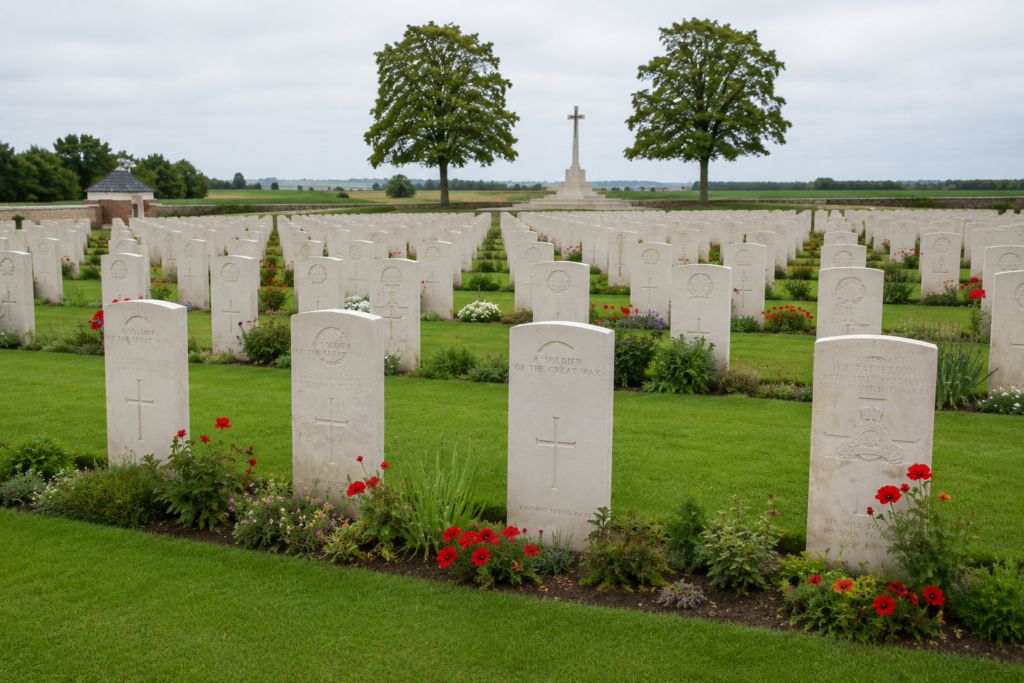
The CWGC website (cwgc.org) has a free grave finder tool. If you have family members buried on the Western Front, identifying their grave and visiting it transforms the trip entirely.
Photography and Conduct
Photography is permitted at all Commonwealth cemeteries and memorials, and at most museums. Walk quietly, stay on paths, and do not touch or climb memorials or grave markers. At German cemeteries, maintain the same respectful conduct — the men buried there were also conscripted and also died in terrible circumstances.
What to Read Before You Go
The Western Front is best visited with some reading behind you. The history carries more weight when you understand what was at stake, what went wrong, and what the experience felt like for the men living through it.
- Lyn Macdonald — Somme (1983) — the definitive oral history of the Battle of the Somme
- Lyn Macdonald — They Called It Passchendaele — same approach applied to the Third Battle of Ypres
- Siegfried Sassoon — Memoirs of an Infantry Officer — fiction, but almost entirely autobiographical
- Sebastian Faulks — Birdsong — not history but perhaps the best novel for emotional preparation
- John Keegan — The Face of Battle — the essential analytical history of battle experience at Agincourt, Waterloo, and the Somme
- Major & Mrs Holt’s Battlefield Guides — the practical series, updated regularly, one volume each for the Somme and Ypres
Tour Operator Options (If You Want Guided Elements)
An independent road trip does not mean you have to avoid guided elements entirely. Many visitors opt for a self-drive trip with one or two specialist guided experiences built in — particularly for sites that benefit from expert interpretation.
- Leger Holidays — the UK’s largest specialist battlefield tour operator; also offers day extensions from self-drive visitors at some sites
- Anglia Tours — specialist WWI and WWII tour operator with deep guide expertise in the Ypres Salient and Somme
- GetYourGuide — the best platform for booking individual guided tours, including half-day and full-day Somme and Ypres tours
- Viator — strong alternative to GetYourGuide with good Normandy and Flanders tour coverage
- Flanders Battlefield Tours — Ypres-based specialist; highly regarded for small group tours and bespoke itineraries
| AFFILIATE NOTEBattleground History earns a small commission on bookings made via GetYourGuide and Viator at no cost to you. This helps fund the research and writing that keeps the site independent. |
Budget Guide
The Western Front road trip is one of the more accessible major history trips in Europe. The majority of the most significant sites — the cemeteries, memorials, and preserved battlefield landscape — are free to visit.
| Eurotunnel (return) | From £80pp if booked in advance; can rise significantly in peak season. Book early. |
| Fuel | Belgium and France are broadly comparable to UK fuel prices. Budget approximately £60–80 for fuel across a 7-day trip. |
| Accommodation | Hotels in Ypres and Arras from £70–100 per night for a double room. Rural gites can be cheaper, particularly outside peak season. |
| Museum entry | In Flanders Fields Museum: approximately £12 adult. Wellington Quarry, Arras: approximately £10. Most other sites: free. |
| Food | Belgium has excellent and affordable cafes and restaurants. Northern France is similarly good value outside major tourist towns. Budget £25–35pp per day for food. |
| Guided tours | Half-day guided tours from specialist operators typically £30–60pp; full days £60–120pp. |
The Road Less Travelled: Quieter Somme and Salient Sites
The main sites receive the most visitors for good reason — they are the most significant. But the Western Front rewards those who leave the main circuit. Some of the most affecting experiences come from small cemeteries with 50 graves rather than 10,000, or from a farm track that crosses a ridge where an entire battalion was lost in an afternoon.
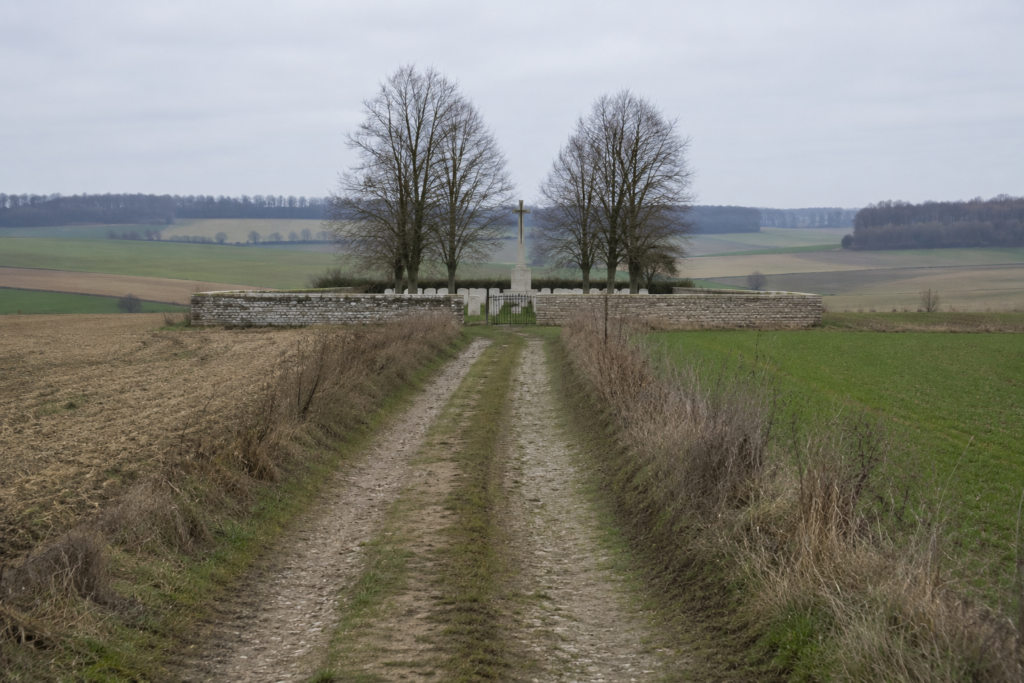
- Guards Cemetery, Lesboeufs — on the Somme, one of the most beautiful CWGC cemeteries; rarely visited outside of military pilgrimage groups
- Pheasant Wood Cemetery, Fromelles — created only in 2010 after the discovery and identification of 250 Australian and British soldiers; the most recently constructed CWGC cemetery
- German concrete bunkers, Langemark — heavy German fortifications visible in the churchyard; Langemark German Cemetery itself is one of the most sombre in Belgium
- Railway Hollow Cemetery, Serre — one of the smallest and most isolated cemeteries on the Somme; 107 graves, reached by a narrow farm track
- Pool of Peace (Lone Tree Crater), Spanbroekmolen — a water-filled mine crater detonated in June 1917, now surrounded by trees and almost completely overlooked
A Final Note on the Experience
The Western Front is not a theme park, and it is not simply a sequence of sites to be photographed and ticked off. It is a landscape where industrial-scale killing happened over four years within living memory of people who are still alive today. The men buried in those cemeteries were, in the vast majority of cases, conscripts — young men who had no choice about being there.
The independent road trip gives you the time and freedom to absorb this properly. To sit in a cemetery long enough to read more than three or four headstones. To park on a ridge and look at the ground and understand, even slightly, what it meant to cross it on foot while it was defended.
Come prepared. Come respectfully. Come with enough time. The Front will not leave you unchanged.
| PLAN YOUR TRIP See also: Visiting Ypres — The Menin Gate, Tyne Cot, and the Salient | The Somme Battlefield: A Visitor’s Complete Guide | The Best WWI Battlefield Tours from the UK | WWI Cemeteries and Memorials: A Guide to CWGC Sites |